
The Application Gallery features COMSOL Multiphysics® tutorial and demo app files pertinent to the electrical, structural, acoustics, fluid, heat, and chemical disciplines. You can use these examples as a starting point for your own simulation work by downloading the tutorial model or demo app file and its accompanying instructions.
Search for tutorials and apps relevant to your area of expertise via the Quick Search feature. Note that many of the examples featured here can also be accessed via the Application Libraries that are built into the COMSOL Multiphysics® software and available from the File menu.
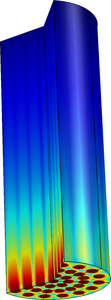
One of the most common reactors in the chemical industry, for use in heterogeneous catalytic processes, is the packed bed reactor. This type of reactor is used both in synthesis as well as in effluent treatment and catalytic combustion. This model is set up to calculate the ... Read More
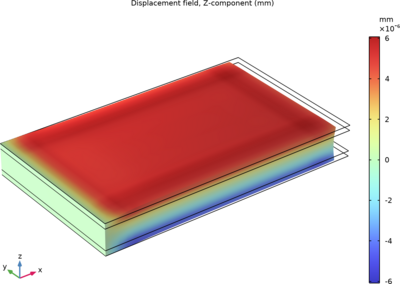
This tutorial is intended as a simple example showing how to model piezoelectric devices using the layered shell functionality. Two cases of material orientation are studied. In the first case, the pole axis is normal to the shell surface, which results in a thickness change. In the ... Read More
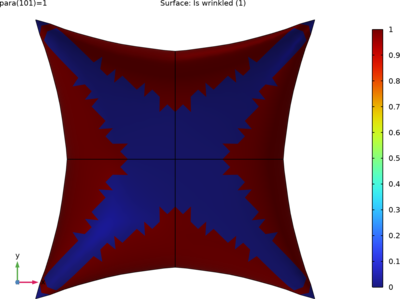
A square airbag is inflated using constant air pressure. In some regions of the airbag the material wrinkles during inflation, as negative principal stresses develop. The wrinkling membrane model within the tension field theory gives a correct description of the stress distribution and ... Read More
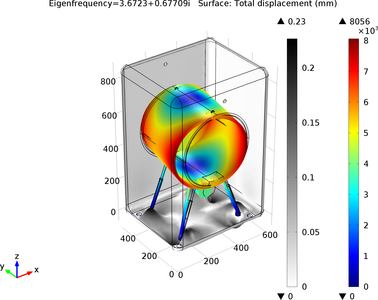
Vibration and noise caused by the nonuniform distribution of clothes in the drum are common problems in washing machines and are important considerations in their design and optimization. This model simulates a horizontal-axis portable washing machine using the Multibody Dynamics ... Read More
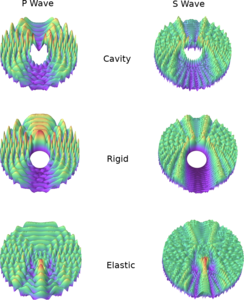
This model showcases how to solve for the scattered field when knowing the incident field for three different types of scatterer, that is, an infinitely rigid one, a cavity and an elastic inclusion. This formulation can be useful when the scatterer is in the far field of the source, so ... Read More
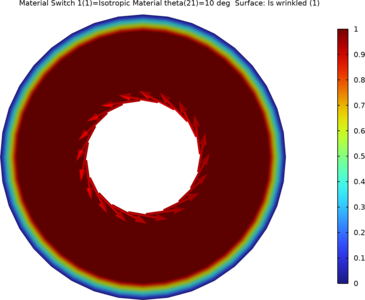
In this example, a torque is applied to the inner edge of a circular annulus-shaped membrane while the outer edge is fixed, resulting in wrinkling of the membrane. The wrinkling membrane model avoids the equilibrium instability that would be produced by the compressive stresses. The ... Read More
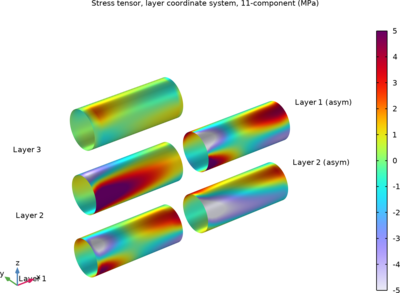
Fiber composites are widely used in industrial applications. Compared with traditional metallic engineering materials, fiber composites often offer higher specific stiffness and strength, as well as greater corrosion resistance. In addition, properties such as strength, stiffness, and ... Read More
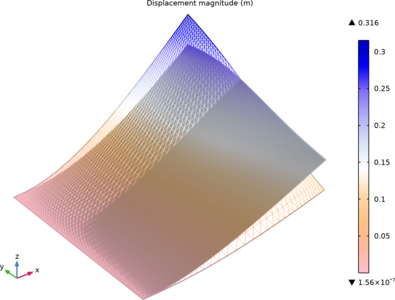
Composite laminates are synthetic structures and there is always a possibility to optimize the design in terms of the number of layers, the material of each layer, the thickness of each layer, and the stacking sequence for the specified loading conditions. Designers need to know how safe ... Read More
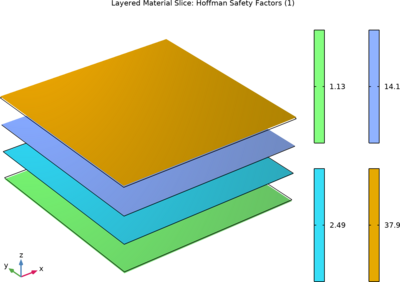
Laminated composite shells made of carbon-fiber-reinforced polymer (CFRP) are common in a large variety of applications due to their high strength-to-weight ratio. Evaluation of the structural integrity of a laminated composite shell for a set of applied loads is necessary to make the ... Read More
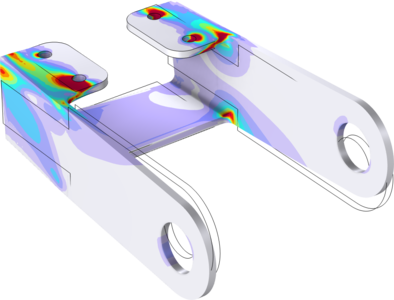
The bracket model tutorials are used as an introduction to the features and functionality within the Structural Mechanics Module. The following features are introduced: The following features are introduced: The fundamentals: static linear analysis Parametric study Including initial ... Read More


