
The Application Gallery features COMSOL Multiphysics® tutorial and demo app files pertinent to the electrical, structural, acoustics, fluid, heat, and chemical disciplines. You can use these examples as a starting point for your own simulation work by downloading the tutorial model or demo app file and its accompanying instructions.
Search for tutorials and apps relevant to your area of expertise via the Quick Search feature. Note that many of the examples featured here can also be accessed via the Application Libraries that are built into the COMSOL Multiphysics® software and available from the File menu.
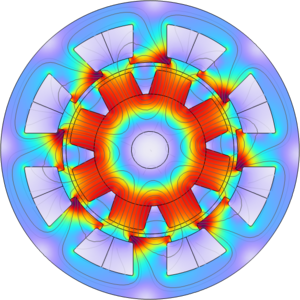
In this model, a rotor with permanent magnets and a nonlinear magnetic material rotates within a stator of the same magnetic material. The generated voltage in windings around the stator is calculated as a function of time. COMSOL Multiphysics models the rotation with assemblies and ... Read More
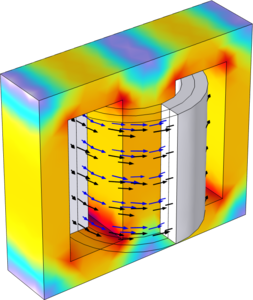
This is the transient model of a single phase E-core transformer using a homogenized approach for the multi-turn primary and secondary coils. The model includes the effect of magnetic saturation (B–H curve) in the core and shows how to connect the transformer model to the external ... Read More
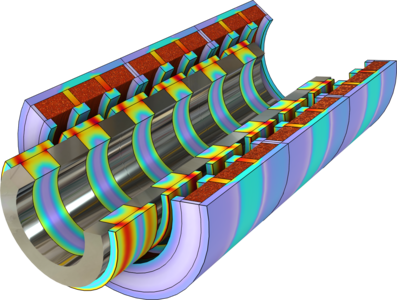
This tutorial shows how to model the tubular permanent magnet generator in 2D axisymmetry. The generator consists of a modular stationary stator and moving/oscillating slider. The stator is made of three-phase multiturn windings and an iron core. The slider is made of permanent magnets ... Read More
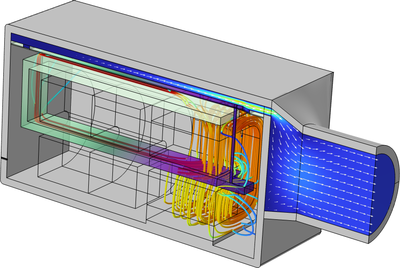
This is a full vibro-electroacoustic simulation of a balanced armature transducer (BAT or also known as a receiver in some industries) which is a high-performance miniature loudspeaker often used in hearing aids and other in-ear audio products such as earbuds. The model is set up and ... Read More
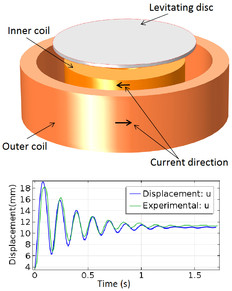
This model presents a solution to the Transient Electromagnetic Analysis Methods (TEAM) workshop problem 28, “An Electrodynamic Levitation Device”- a benchmark problem involving the dynamic coupling of electromagnetics and rigid body dynamics. An electrodynamic levitation force is ... Read More
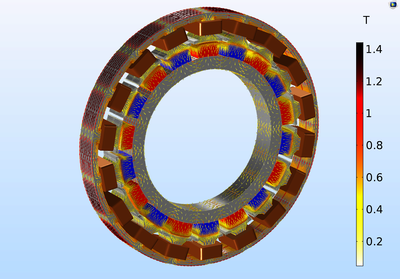
Permanent magnet (PM) motors are used in many high-end applications, such as in electric and hybrid vehicles. An important design limitation is that the magnets are sensitive to high temperatures, which can occur through heat losses caused by currents, particularly eddy currents. In ... Read More
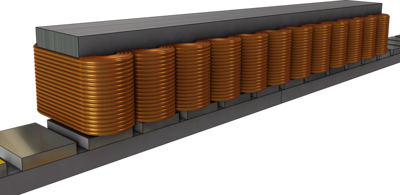
Linear motors are used in many applications in need of translational motion. Typical characteristics of linear motor designs are high precision or quick acceleration. This model investigates a synchronous motor with three-phase winding on the stationary part and permanent magnets on the ... Read More
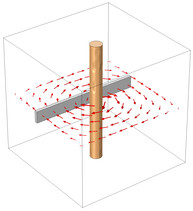
When a conductive solid material moves through a static magnetic field, an eddy current is induced. The current that flows through the conductor, which is itself moving through the magnetic field, induces a Lorentz force back on the solid. Therefore, a conductive solid that is vibrating ... Read More
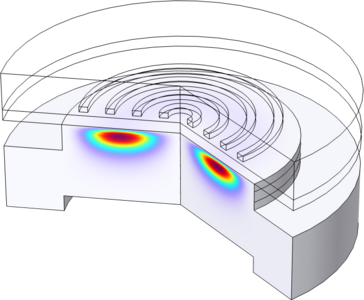
This tutorial model solves for an inductively coupled plasma reactor in a mixture of CF4/O2. The plasma transport, magnetic fields, fluid flow, and heat transfer are solved for fully self-consistently. The oxygen mole fraction of the reactor feed is parameterized. Read More
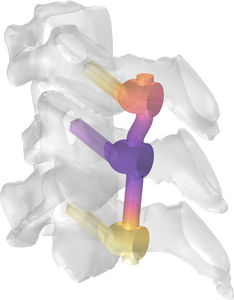
Tutorial example of the RF heating of passive conductive implants (rod and screws) inserted in three vertebrae during MRI. The RF fields are locally enhanced in the proximity of a passive conductive implant resulting in the heating of the portion of tissue facing the implant's surface. Read More


