
The Application Gallery features COMSOL Multiphysics® tutorial and demo app files pertinent to the electrical, structural, acoustics, fluid, heat, and chemical disciplines. You can use these examples as a starting point for your own simulation work by downloading the tutorial model or demo app file and its accompanying instructions.
Search for tutorials and apps relevant to your area of expertise via the Quick Search feature. Note that many of the examples featured here can also be accessed via the Application Libraries that are built into the COMSOL Multiphysics® software and available from the File menu.
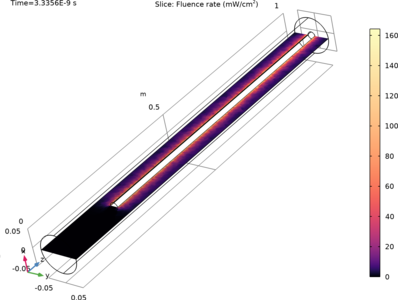
This model demonstrates how to compute the volumetric fluence rate in an ultraviolet (UV) reactor. The geometry is the annular fluid region surrounding a cylindrical lamp. The effect of reflection at the reactor walls on the radial fluence rate distribution is considered. Read More
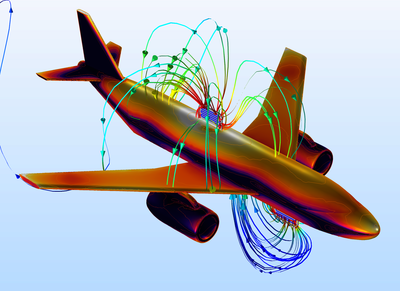
Antenna crosstalk, or co-site interference, is problematic when multiple antennas are used on a single large platform. In this model, the interference between two identical antennas at VHF frequency is studied with an S-parameter analysis of different configurations of a receiving ... Read More
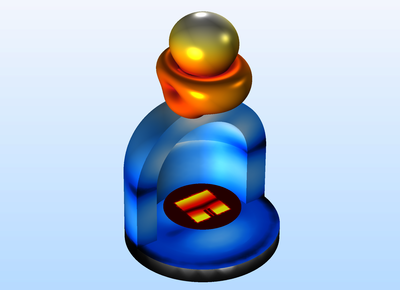
A radome minimizes losses and improves radiation characteristics of an antenna through its design. The structure can be optimized to minimize the transmission loss and also designed to improve radiation characteristics including antenna directivity and side lobes. Shown in the model is ... Read More
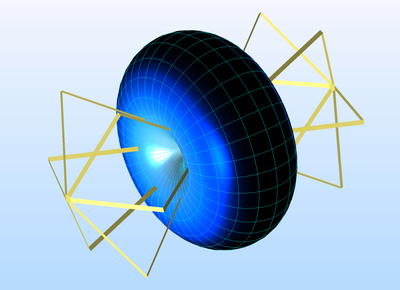
Biconical antennas are popular for very high frequency (VHF) measurement because they support a wide frequency range. They are also useful for electromagnetic compatibility (EMC) testing where the antenna can be used as an RF source in susceptibility or immunity test. This model ... Read More
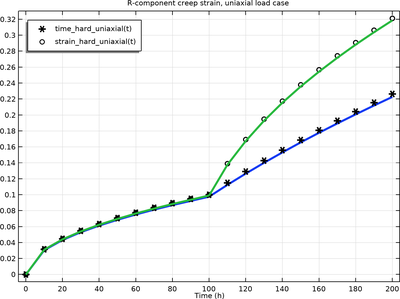
In this model example, you will study the creep behavior of material under non-constant loading. You will model the primary creep using a Norton–Bailey law and study the difference between the time hardening and the strain hardening methods available in COMSOL Multiphysics. The model is ... Read More
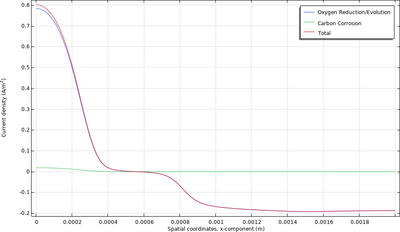
Carbon corrosion is one of the important degradation mechanisms in a Polymer Electrolyte Membrane (PEM) fuel cells which predominantly occurs during start-up or shut down of the fuel cells. During carbon corrosion, carbon support to catalysts is compromised affecting the cell ... Read More
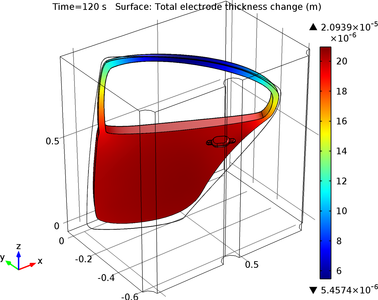
This example models electrocoating of paint onto a car door in a time-dependent simulation. The deposited paint is highly resistive which results in lowered local deposition rates for coated areas. A primary current distribution in combination with a film resistance model is used to ... Read More
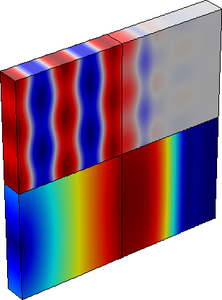
This small tutorial model shows how to set up a model with a solid mechanics and a pressure acoustics domain including a common perfectly matched layer (PML). The PML is used to model an open or infinite domain for both the elastic waves and the pressure waves. Three configurations of ... Read More

In small PEM fuel cell systems (in the sub-100 W range) no active devices for cooling or air transport are normally used. This is due to the desire to minimize parasitic power losses from pumps and fans, and to reduce the system complexity, size, and cost. The reactants at the cathode ... Read More
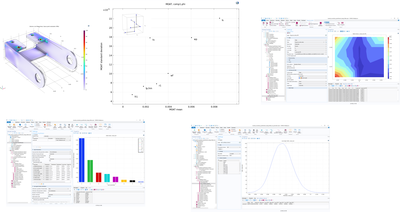
This example demonstrates how to use the Uncertainty Quantification Module by running a series of uncertainty quantification studies for a steel bracket. This type of bracket can be used to install an actuator that is mounted on a pin placed between the two holes in the bracket arms. ... Read More


