
The Application Gallery features COMSOL Multiphysics® tutorial and demo app files pertinent to the electrical, structural, acoustics, fluid, heat, and chemical disciplines. You can use these examples as a starting point for your own simulation work by downloading the tutorial model or demo app file and its accompanying instructions.
Search for tutorials and apps relevant to your area of expertise via the Quick Search feature. Note that many of the examples featured here can also be accessed via the Application Libraries that are built into the COMSOL Multiphysics® software and available from the File menu.
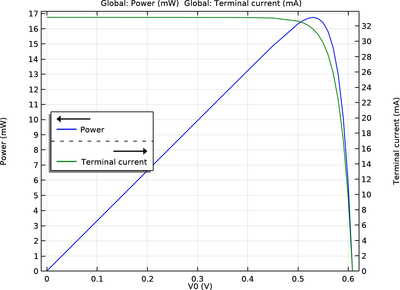
This tutorial uses a simple 1D model of a silicon solar cell to illustrate the basic steps to set up and perform a device physics simulation with the Semiconductor Module. A user-defined expression is used for the photo-generation rate and the result shows typical I–V and P–V curves of ... Read More
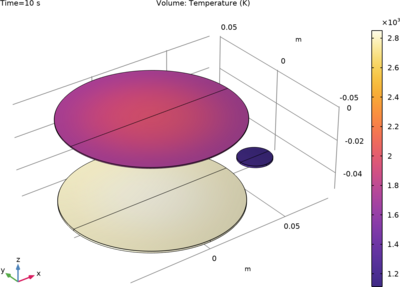
In the semiconductor industry, rapid thermal annealing (RTA) is a semiconductor process step used for the activation of dopants and the interfacial reaction of metal contacts. In principle, the operation involves rapid heating of a wafer from ambient to approximately 1000–1500 K. As soon ... Read More
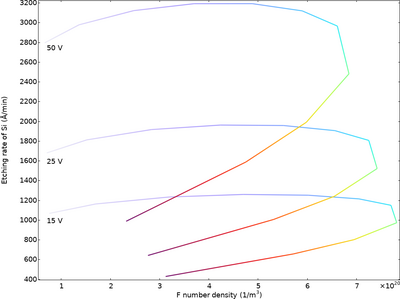
In this example, the etching of silicon in a CF4/O2 plasma reactor is studied using a global model. Parametric sweeps for ion energy and oxygen mole fraction are computed. Read More
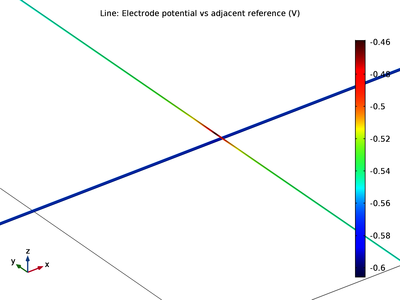
The impressed current cathodic protection (ICCP) system is often employed to mitigate corrosion of buried pipelines in the oil and gas industry. Metallic objects such as buried pipelines, which are present within the current flow of the ICCP system, may suffer from the stray current ... Read More

This model studies the natural frequencies of a pre-tensioned string using the 2D Wire interface. This is an example of “stress stiffening”; in fact the transverse stiffness of wire elements is directly proportional to the tensile force. Strings made of piano wire have an extremely high ... Read More
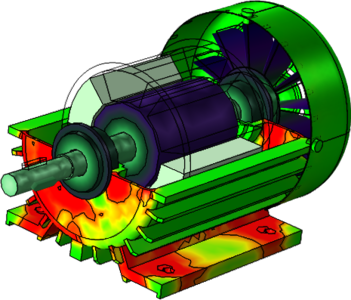
This is an example of a model of an induction motor in which eddy currents are induced in the rotor by time-harmonic currents in the stator windings and the rotor's rotation. Induced currents in the rotor interact with the magnetic field that is produced by the coils to generate the ... Read More
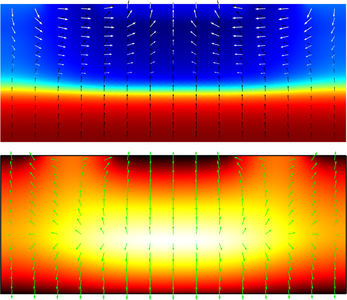
This model demonstrates how to couple the Semiconductor interface to the Heat Transfer in Solids interface. A thermal analysis is performed on the existing bipolar transistor model in the case when the device is operated in the active-forward configuration. The Semiconductor interface ... Read More
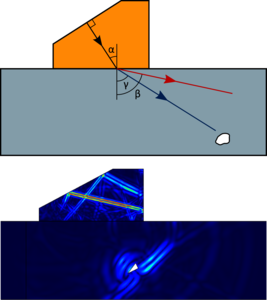
Angle beam ultrasonic units are used for nondestructive testing (NDT) of solid objects, such as metal pipes. They are especially useful for detecting flaws in and around welding areas, such as pores, small cracks, lack of fusion, etc. Angle beam NDT is often used where the straight beam ... Read More
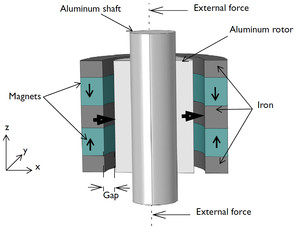
This model illustrates the working principle of a passive electrodynamic bearing. An electrically conducting rotor rotating in a magnetic field produced by a permanent magnets induces eddy currents on the conducting rotor. The eddy currents, in turn, produce a magnetic field that opposes ... Read More
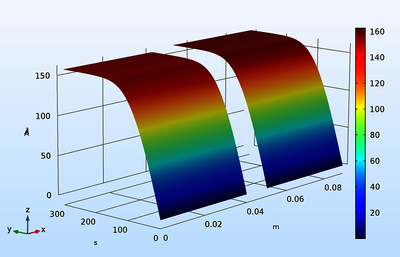
Surface chemistry is often an overlooked aspect of reacting flow modeling. This tutorial model shows how surface reactions and species can be added to study processes like chemical vapor deposition (CVD). The tutorial then models silicon growth on a wafer. Initially, the example uses a ... Read More


