
The Application Gallery features COMSOL Multiphysics® tutorial and demo app files pertinent to the electrical, structural, acoustics, fluid, heat, and chemical disciplines. You can use these examples as a starting point for your own simulation work by downloading the tutorial model or demo app file and its accompanying instructions.
Search for tutorials and apps relevant to your area of expertise via the Quick Search feature. Note that many of the examples featured here can also be accessed via the Application Libraries that are built into the COMSOL Multiphysics® software and available from the File menu.
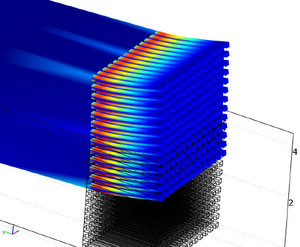
In nature, geckos use dry adhesion forces to climb walls. They have inspired researchers to develop synthetic gecko foot hairs to be used in, for example, robot applications. This model contains the nano/micro hierarchy of a synthetic gecko foot hair, where cantilever beams both in nano ... Read More

A large reflector can be modeled easily with the 2D axisymmetric formulation. In this model, the radius of the reflector is greater than 20 wavelengths and the reflector is illuminated by an axial feed circular horn antenna. The simulated far-field shows a high-gain sharp beam pattern Read More
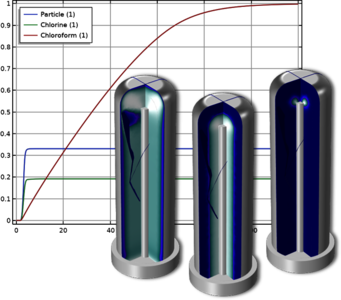
This example illustrates how to model the transport of different contaminants through a ceramic water filter candle with an activated carbon core. These types of water filters can be found in table top gravity filters, as well as attached to the faucet or as part of a larger reverse ... Read More
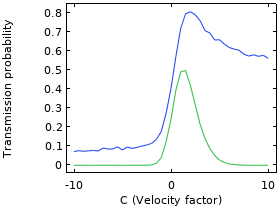
The Monte Carlo simulation of flow in a turbomolecular pump can be greatly simplified if the mean radius of the blades is much greater than the spacing between them. Under these conditions, the rotating blades of the pump can be approximated as an infinite row of blades having only ... Read More
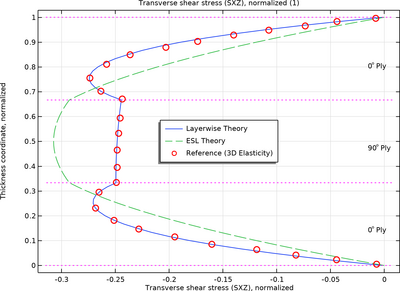
This example demonstrates the bending analysis of a simply supported composite laminate under sinusoidal distributed transverse load. The composite laminate is thick, with a thickness to side length ratio of 1/4. The laminate has three layers in a cross-ply layup. The model is solved ... Read More
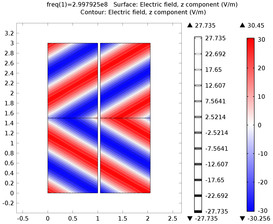
It is possible to engineer the structure of materials such that both the permittivity and permeability are negative. Such materials are realized by engineering a periodic structure with features comparable in scale to the wavelength. It is possible to model both the individual unit cells ... Read More
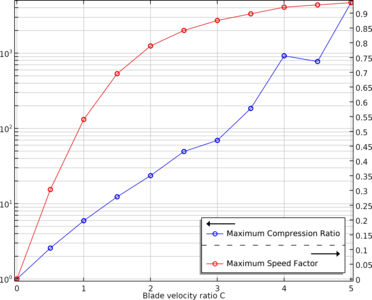
The Free Molecular Flow interface, available in the Molecular Flow Module, is an efficient tool for modeling extremely rarefied gases when the gas molecules move much faster than any geometric entities in the domain. For turbomolecular pumps, in which the blades move at speeds comparable ... Read More
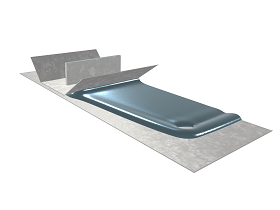
This is a tutorial of a slot die coating process in 3D where the channel is obstructed. The example uses a two-phase flow phase-field method with a non-Newtonian power-law fluid. The effects on the film thickness of the channel obstruction can clearly be seen. Read More

This tutorial models the intercoupled electrochemical reactions, charge and species transport as well as heat transfer in a polymer electrolyte membrane (PEM) fuel cell. For the gas flow fields, straight channels are used on the hydrogen anode side, whereas a mesh structure is used on ... Read More
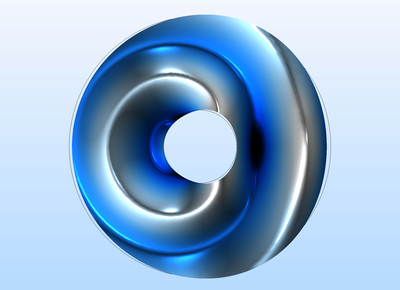
This example model calculates the bistatic radar cross section (RCS) per unit length of a circle using the Electromagnetic Waves, Time Explicit physics interface. A 2D circle is excited by a 200 MHz sinusoidal signal modulated by a temporal Gaussian pulse. A wideband RCS frequency ... Read More


