
The Application Gallery features COMSOL Multiphysics® tutorial and demo app files pertinent to the electrical, structural, acoustics, fluid, heat, and chemical disciplines. You can use these examples as a starting point for your own simulation work by downloading the tutorial model or demo app file and its accompanying instructions.
Search for tutorials and apps relevant to your area of expertise via the Quick Search feature. Note that many of the examples featured here can also be accessed via the Application Libraries that are built into the COMSOL Multiphysics® software and available from the File menu.
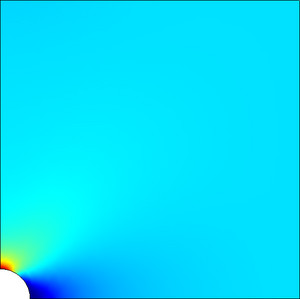
This model describes a static stress analysis to obtain the stress distribution in the vicinity of a small hole in an infinite plate. The model is a classic benchmark and is described in Mechanics of Material, by D. Roylance. The stress level is then compared with the theoretical values. Read More
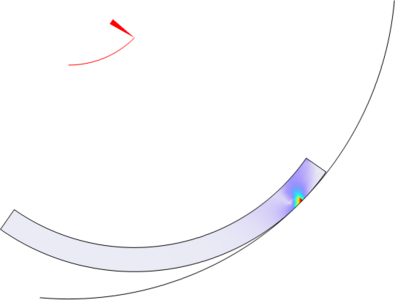
This is a benchmark model involving stick-slip friction of a ring rolling inside another ring. The displacement of the inner ring is computed and compared to the analytical result. This model also shows how to tackle friction dominated contact problem. Read More
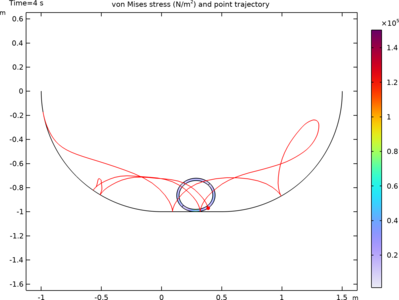
This conceptual example shows how to handle a transient contact problem with stick-slip friction transition. A soft hollow pipe subjected to gravity is released at the top of a halfpipe. The pipe motion varies between sliding and rolling, depending on its position in the halfpipe and its ... Read More
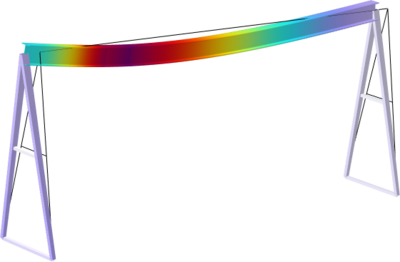
Portal Cranes are common when handling heavy loads. In this example, the Beam interface is used to compute the stresses in a portal crane designed for lifting 15 tons. Three load cases are considered: self weight, payload, and thermal expansion on a hot summer day. An internal hinge ... Read More
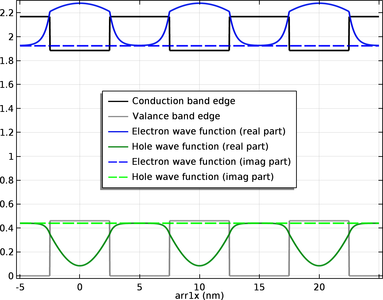
The Superlattice Band Gap Tool model helps the design of periodic structures made of two alternating semiconductor materials (superlattices). The model uses the effective mass Schrödinger equation to estimate the electron and hole ground state energy levels in a given superlattice ... Read More
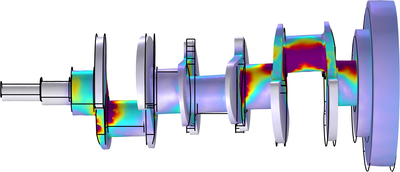
See how to perform a vibration analysis of the crankshaft of a 3-cylinder reciprocating engine in this tutorial model. Due to the eccentricity of the crank-pin and balance masses on the crankshaft, it undergoes self-excited vibration under rotation. The crankshaft is modeled using solid ... Read More
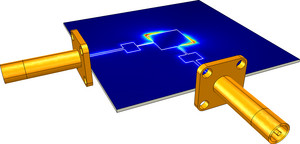
Patch antennas are becoming more common in wireless equipment, like wireless LAN access points, cellular phones, and GPS handheld devices. The antennas are small in size and can be manufactured with simple and cost-effective techniques. Due to the complicated relationship between the ... Read More
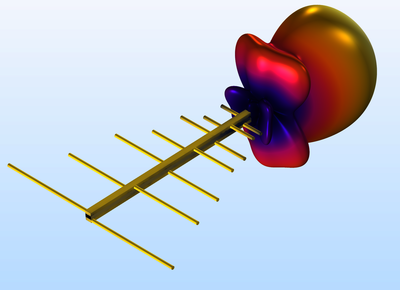
The shape of a log-periodic antenna resembles that of a Yagi-Uda antenna, but is composed of a coplanar array to achieve a wider bandwidth. It is also known as a wideband or frequency-independent antenna. All metallic parts are modeled using the perfect electric conductor (PEC) boundary ... Read More
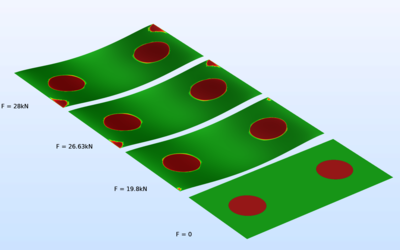
Interfacial failure or delamination in a composite material can be simulated with a cohesive zone model (CZM). A key ingredient of a cohesive zone model is a traction-separation law that describes the softening in the cohesive zone near the delamination tip. This example shows the ... Read More
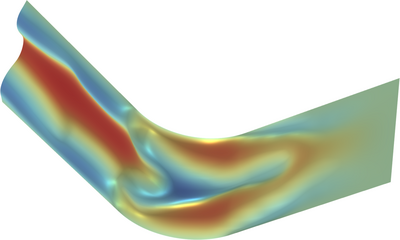
This model demonstrates how to use the Polynomial Shell feature to increase the lowest Eigenfrequency of a shell by deforming its shape. Read More


