The Application Gallery features COMSOL Multiphysics® tutorial and demo app files pertinent to the electrical, structural, acoustics, fluid, heat, and chemical disciplines. You can use these examples as a starting point for your own simulation work by downloading the tutorial model or demo app file and its accompanying instructions.
Search for tutorials and apps relevant to your area of expertise via the Quick Search feature. Note that many of the examples featured here can also be accessed via the Application Libraries that are built into the COMSOL Multiphysics® software and available from the File menu.
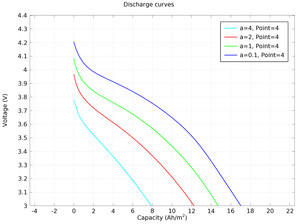
This model demonstrates the Lithium-Ion Battery interface for studying the discharge and charge of a lithium-ion battery for a given set of material properties. The geometry is in one dimension and the model is isothermal. Battery developers can use the model to investigate the influence ... Read More
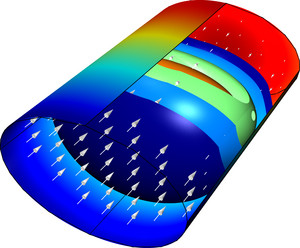
Several factors influence a diesel particulate filter’s (DPF) efficiency and durability. Important issues include the removal of soot particles from the filter membranes and the influence of thermal stress on the ceramic structure, stress that arises during repeated operating cycles. ... Read More
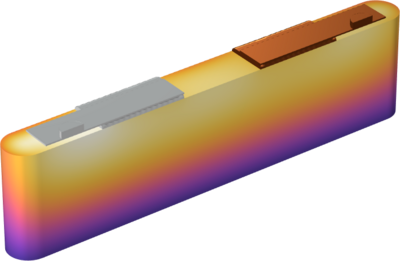
This model exemplifies how to compute the internal temperature distribution in a prismatic battery during a high-rate charge. The electrochemistry is described by a a lumped two-electrode model, which is coupled to the heat transfer model. The heat transfer model includes the effects of ... Read More
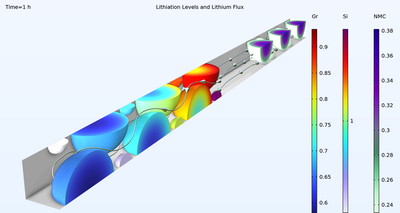
This model describes the behavior of a lithium-ion battery unit cell modeled using an idealized heterogeneous three-dimensional geometry. In contrast to the typical homogenized approach for describing porous electrodes, heterogeneous models define the actual shapes of the electrode ... Read More

The electrodes of a lithium-ion battery are porous, consisting of an active solid material, a binder, and pores filled with liquid electrolyte. If a force is applied on the porous layers of a battery, this will affect the volume fraction of the electrolyte-filled pores in the electrodes, ... Read More
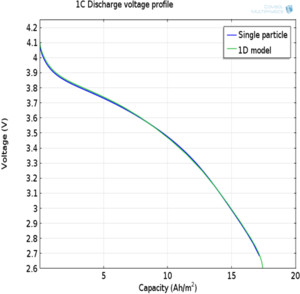
An isothermal single particle model formulation for a lithium-ion battery is presented in this work. The single particle model is a simplification of the 1D formulation for a lithium-ion battery along with a few assumptions. The model is typically valid for low-medium current scenarios. ... Read More

In a lithium metal battery, lithium metal is deposited during charging on the negative electrode. Mass transport and ohmic effects in the electrolyte cause small protrusions on the metal surface to be subjected to accelerated growth during charging. In worst case scenarios, this leads to ... Read More

This model presents a study of the current density distribution in a solid oxide fuel cell (SOFC). The model includes the full coupling between the mass balances at the anode and cathode, the momentum balances in the gas channels, the gas flow in the porous electrodes, the balance of ... Read More
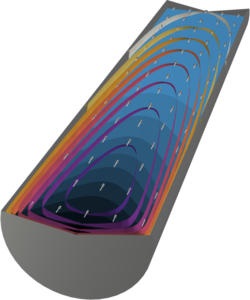
This model uses the Reacting Flow multiphysics interface to simulate a methane steam reformer. The model accounts for the interactions between the chemical reactions, the transport of species, the fluid flow, and the heat transfer in a porous medium. Read More
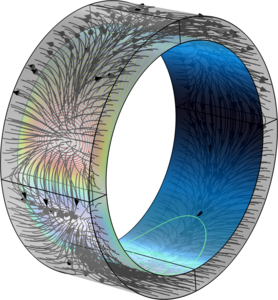
This example describes how to simulate the self-lubricating phenomenon of a liquid lubricant in a journal bearing. A porous bushing is press-fitted to a bearing and saturated with a lubricant. It acts as a reservoir for the redistribution of the thin film of lubricant between regions of ... Read More