
The Application Gallery features COMSOL Multiphysics® tutorial and demo app files pertinent to the electrical, structural, acoustics, fluid, heat, and chemical disciplines. You can use these examples as a starting point for your own simulation work by downloading the tutorial model or demo app file and its accompanying instructions.
Search for tutorials and apps relevant to your area of expertise via the Quick Search feature. Note that many of the examples featured here can also be accessed via the Application Libraries that are built into the COMSOL Multiphysics® software and available from the File menu.
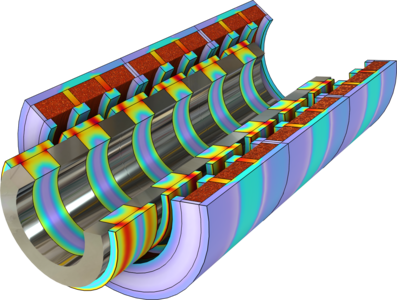
This tutorial shows how to model the tubular permanent magnet generator in 2D axisymmetry. The generator consists of a modular stationary stator and moving/oscillating slider. The stator is made of three-phase multiturn windings and an iron core. The slider is made of permanent magnets ... Read More

A magnetic diaphragm is a flexible, thin structure that interacts with magnetic fields to perform mechanical or sensing functions. When subjected to an external magnetic field, the diaphragm deforms due to magnetomechanical interactions, converting magnetic energy into mechanical ... Read More
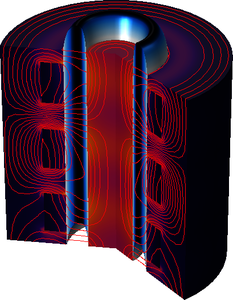
Induction pumps are used in high temperature cooling systems. The principle of operation is equivalent to a linear three phase induction motor. The lack of moving parts and the pumped liquid being kept in a hermetically closed system are clear advantages. This model shows how to simulate ... Read More
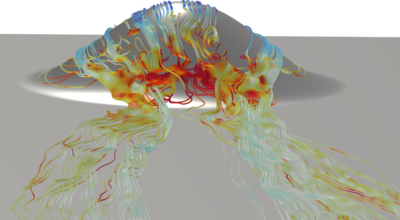
The present example simulates the turbulent flow over a 3D hill geometry using the Large Eddy Simulation (LES) interface with synthetic turbulence at the inlet boundary. Read More
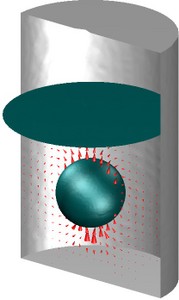
The level set method is well suited for problems with moving boundaries in which the geometry’s topology changes with time. A bubble of oil that travels up through water and finally merges with oil at the top causes this kind of topology change. For problems where the topology is ... Read More
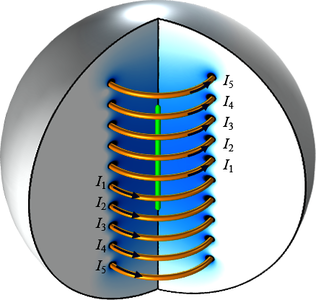
Several different approaches to optimizing a ten-turn axisymmetric coil are presented. First, the current in each turn is adjusted with the objective of having a uniform magnetic flux density along the centerline. Second, the currents are adjusted to minimize power dissipation with a ... Read More

This model describes the corrosion of magnesium (Mg) alloys in physiological environments using a phase-field formulation. The approach couples Mg dissolution kinetics with ionic transport, enabling the transition from activation-controlled to diffusion-controlled regimes to be captured. ... Read More

The mutual inductance and induced currents between a single turn primary and twenty turn secondary coil in a concentric coplanar arrangement is computed using a frequency domain model. Each turn of the secondary coil is modeled explicitly. The results are compared against analytic ... Read More
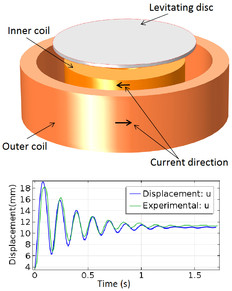
This model presents a solution to the Transient Electromagnetic Analysis Methods (TEAM) workshop problem 28, “An Electrodynamic Levitation Device”- a benchmark problem involving the dynamic coupling of electromagnetics and rigid body dynamics. An electrodynamic levitation force is ... Read More
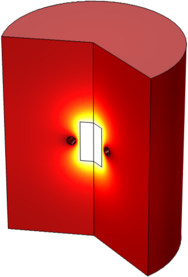
The induced currents in a copper cylinder produce heat that in turn change the electrical conductivity. This means that the field propagation has to be solved simultaneously with the heat transfer through the cylinder and surrounding system. This model shows this coupling between eddy ... Read More


