
The Application Gallery features COMSOL Multiphysics® tutorial and demo app files pertinent to the electrical, structural, acoustics, fluid, heat, and chemical disciplines. You can use these examples as a starting point for your own simulation work by downloading the tutorial model or demo app file and its accompanying instructions.
Search for tutorials and apps relevant to your area of expertise via the Quick Search feature. Note that many of the examples featured here can also be accessed via the Application Libraries that are built into the COMSOL Multiphysics® software and available from the File menu.

The TSSG process, namely Top-Seeded Solution Growth, is a method used to grow SiC single crystals. It has the advantages of lower growth temperature and high crystal quality. This model introduces the simulation method of the TSSG process, obtains the temperature distribution of the ... Read More

Rayleigh-Bénard's convection cells is a classic in fluid dynamics. We present here two different approaches for computing the critical Rayleigh number above which the cells form. Read More
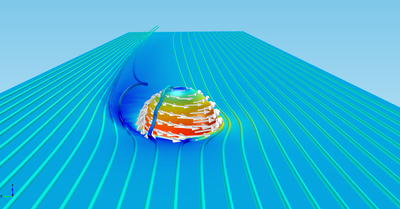
The Magnus effect explains the curl that soccer players can give the ball, resulting in the enjoyable goals that we can see in every FIFA World Cup™. This model looks at the Magnus effect in the laminar and turbulent flow regimes for transient and stationary flows. It also discusses ... Read More
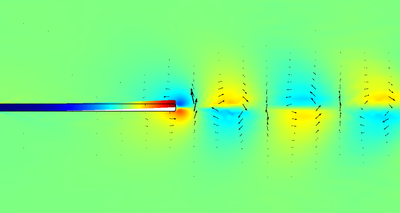
This is a small 2D demonstration model that couples the Linearized Navier-Stokes, Frequency Domain, Solid Mechanics, and Turbulent Flow (k-epsilon) physics interfaces to model the vibrations of a plate located in a 2D viscous parallel plate flow. This type of model is used to model fluid ... Read More
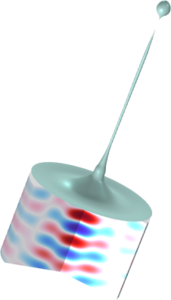
Acoustic droplet ejection is a non-contact, highly controllable method for liquid handling emerging in applications such as printing, biomedical, semiconductor assembly, and mass spectroscopy. The modeling approach assumes separation of acoustic and flow time scales. First, a focused ... Read More
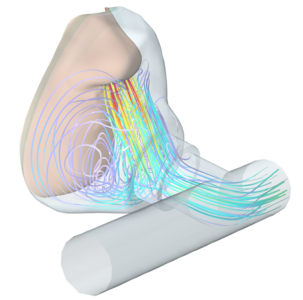
When designing oxygen masks for delivering respiratory support to patients via BiPAP and CPAP, multiphysics modeling helps visualize the flow pattern inside the mask for a given design. From there, it is possible to estimate oxygen consumption, carbon dioxide accumulation, and ... Read More
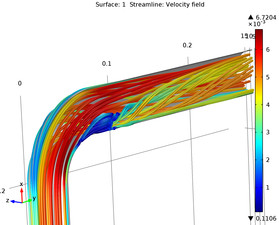
This example models the flow in a 90-degree pipe elbow. The flow is simulated using the k-omega turbulence model. The result is compared to engineering correlations. Read More
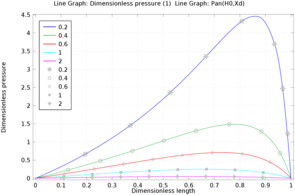
This benchmark model computes the load-carrying capacity of a one dimensional hydrodynamic slider bearing. The results are compared with analytic expressions obtained by solving the Reynolds equations directly in this simple case. Read More
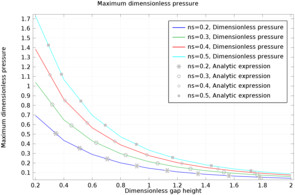
This benchmark model computes the load-carrying capacity of a one dimensional hydrodynamic step bearing. The results are compared with analytic expressions obtained by solving the Reynolds equations directly in this simple case. Read More
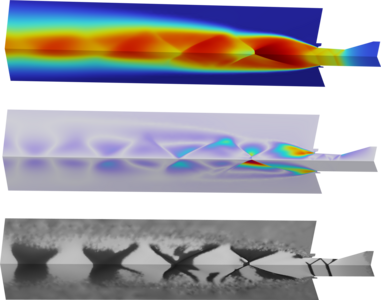
In this example, the High Mach Number Flow, Low Reynolds Number k-e interface is used to compute the compressible turbulent flow from a rectangular nozzle. Mesh refinement based on the estimation of the shock strength and the shear-layer strength is employed to achieve appropriate ... Read More


