
The Application Gallery features COMSOL Multiphysics® tutorial and demo app files pertinent to the electrical, structural, acoustics, fluid, heat, and chemical disciplines. You can use these examples as a starting point for your own simulation work by downloading the tutorial model or demo app file and its accompanying instructions.
Search for tutorials and apps relevant to your area of expertise via the Quick Search feature. Note that many of the examples featured here can also be accessed via the Application Libraries that are built into the COMSOL Multiphysics® software and available from the File menu.
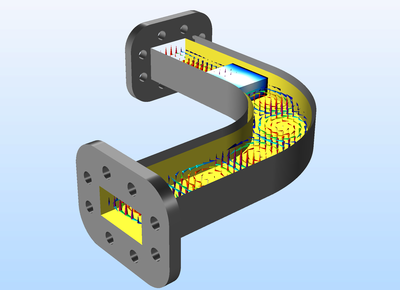
This is a model of an RF waveguide bend with a dielectric block inside. There are electromagnetic losses in the block as well as on the waveguide walls which cause the assembly to heat up over time. The material properties of the block are functions of temperature. The transient thermal ... Read More
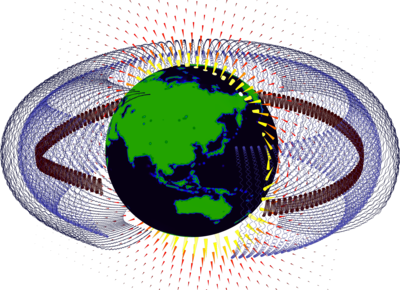
This model demonstrates the path of relativistic protons within Earth's magnetic field. Due to the dipole nature of Earth's magnetic field, charged particles, such as electrons and protons, can get trapped in stable configurations within it for long periods of time. These ... Read More
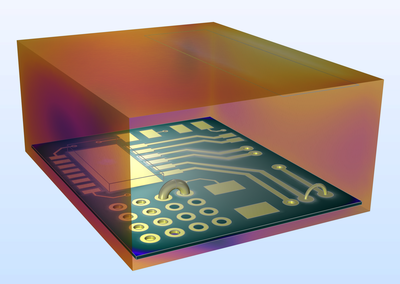
This example provides a walkthrough on how to simulate the basic radiated emission of a printed circuit board and its immunity response from outside noise. First, when one of the microstrip lines is excited, the crosstalk to an adjacent printed line and the radiated field, through an ... Read More
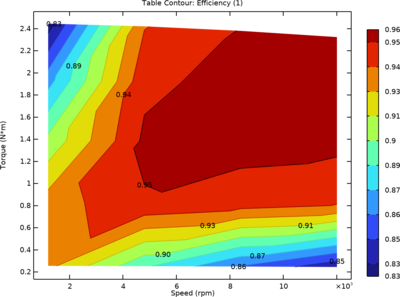
When electrical energy is converted into mechanical work in an electrical motor, the "wasted" energy that causes device heating is usually referred to as loss. The ratio of useful work to input energy, or the efficiency of the motor, is an important property for the overall energy ... Read More
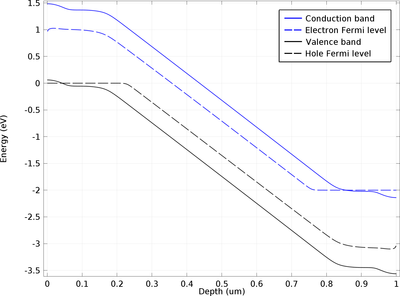
This simple model demonstrates how to use the Semiconductor Optoelectronics interfaces to model a simple GaAs PIN diode structure. Both the stimulated and spontaneous emission in the semiconductor are accounted for. The corresponding absorption of the light and the associated change in ... Read More
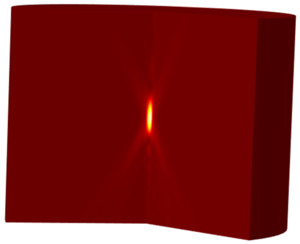
This tutorial shows how to model tissue heating induced by focused ultrasound. First, the stationary acoustic field in the water and the tissue are modeled to obtain the acoustic intensity distribution in the tissue. The absorbed acoustic energy is then calculated and used as the heat ... Read More
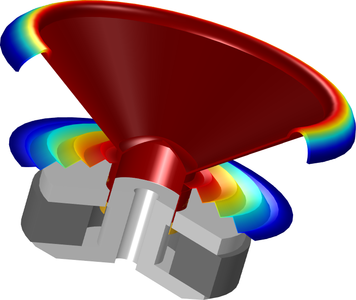
This example shows how to model a loudspeaker driver of the dynamic cone type, common for low and medium frequencies. The analysis is carried out in the frequency domain and thus represents the linear behavior of the driver. The model analysis includes the total electric impedance and ... Read More
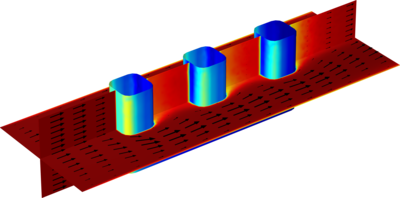
The electrochemical cell shown in this model can be regarded as a unit cell of a larger wire-mesh electrode that is common in many industrial processes. One of the most important aspects in the design of electrochemical cells is the current density distributions in the electrolyte and ... Read More
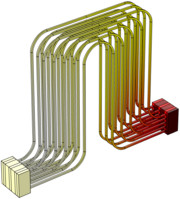
This model simulates a temperature profile in a number of cells and cooling fins in a liquid-cooled battery pack. The model solves in 3D and for an operational point during a load cycle. A full 1D electrochemical model for the lithium battery calculates the average heat source. Read More
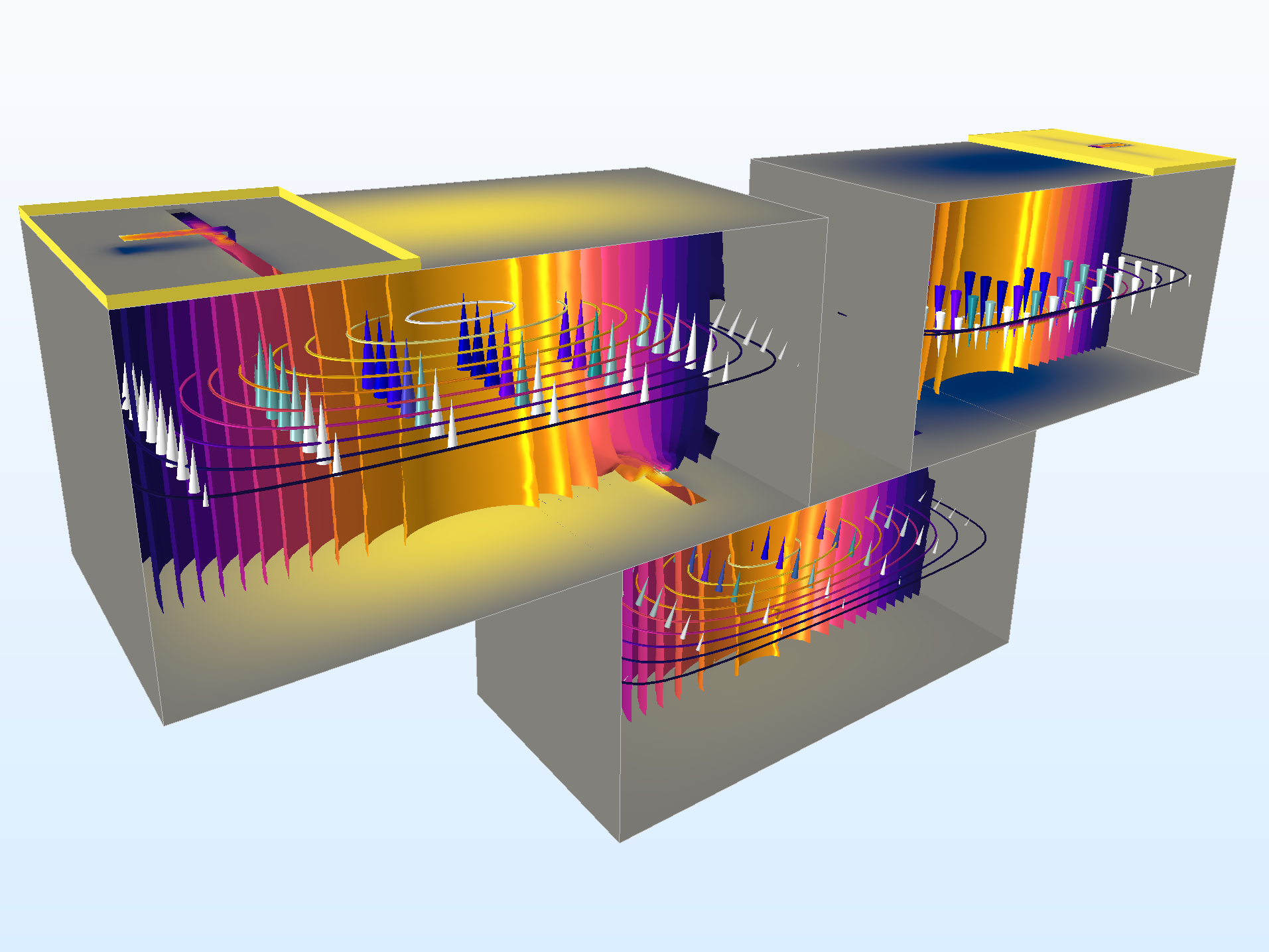
A cascaded cavity filter provides much better bandpass filter performance compared to a single cavity. Out-of-band rejection improves dramatically using a cascaded design. This model uses three rectangular cavity filters coupled via slots. The calculated S-parameters show excellent out ... Read More


