
The Application Gallery features COMSOL Multiphysics® tutorial and demo app files pertinent to the electrical, structural, acoustics, fluid, heat, and chemical disciplines. You can use these examples as a starting point for your own simulation work by downloading the tutorial model or demo app file and its accompanying instructions.
Search for tutorials and apps relevant to your area of expertise via the Quick Search feature. Note that many of the examples featured here can also be accessed via the Application Libraries that are built into the COMSOL Multiphysics® software and available from the File menu.
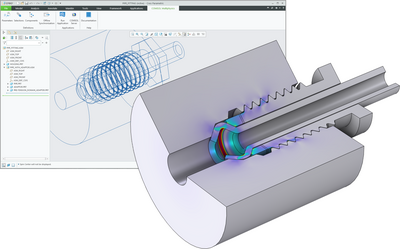
This tutorial model shows the setup of a 2D axisymmetric stress analysis, through contact, of a 3D threaded pipe fitting. The example involves synchronizing the 3D PTC Creo Parametric™ geometry and selections, which specify the faces in contact, with the 2D geometry in COMSOL ... Read More
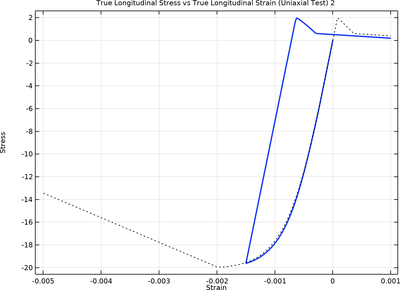
This example shows the behavior of the coupled damage-plasticity material model for concrete when subjected to different loading conditions. Read More
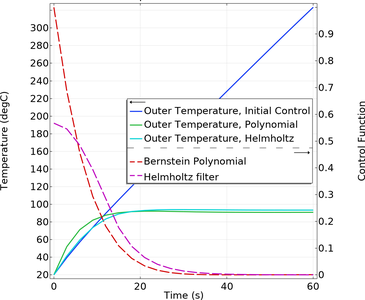
This is an example of optimal control, where the input heating power to a rod is optimized to give a certain temperature on the outside of the rod. This is where the maximum water temperature occurs, while the minimum occurs at the center. Therefore this problem corresponds to the ... Read More
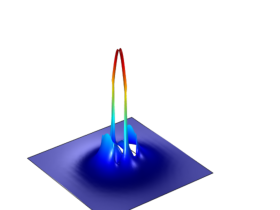
The model analyses the mode propagation within a nano slot waveguide. In a slot waveguide configuration, two high refractive index slabs (~3.48) are placed adjacent to the low refractive index slot (~1.44). Mode analysis was performed on a 2D cross section of a slot waveguide for an ... Read More
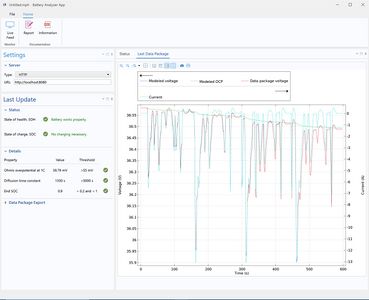
These two apps can be run to set up a digital twin of an electric scooter battery. The Digital Twin Simulator of an Electric Scooter Battery (the "simulator" app) simulates the use of an electric scooter and generates battery current and voltage data over time. The Digital Twin ... Read More
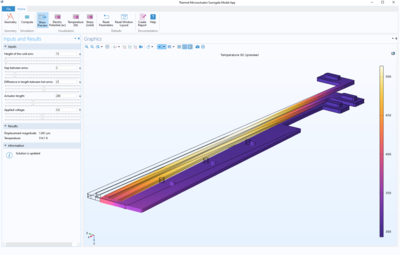
The Thermal Actuator Surrogate Model Application demonstrates how the computational speed can be increased with the use of a surrogate model. This app demonstrates the following: Adjusting input parameters via sliders, with near-instantaneous updates to the solution retrieved from the ... Read More
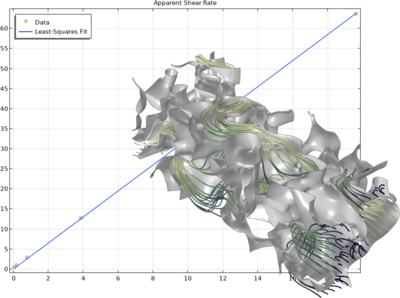
Non-Newtonian fluids have complex flow characteristics that vary with shear rate, making their behavior in porous materials difficult to predict. Pore scale modeling captures these flow patterns at a microscopic level, helping derive properties for macroscale use. This model ... Read More
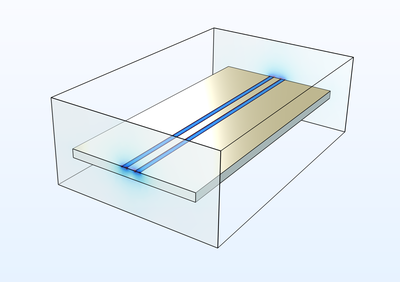
This tutorial example shows how to set port features in a physics interface when designing a coplanar waveguide (CPW) circuit that is useful for mmWave applications. Read More
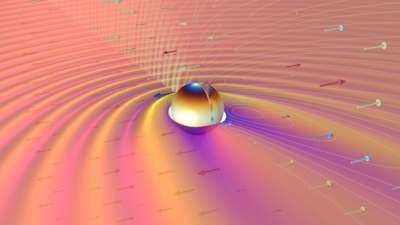
This model illustrates the process of evaluating the radar cross section (RCS) of a metallic sphere through the utilization of the boundary element method (BEM). By taking advantage of a vertical symmetry plane that is parallel to the polarization of an incident background field, the ... Read More
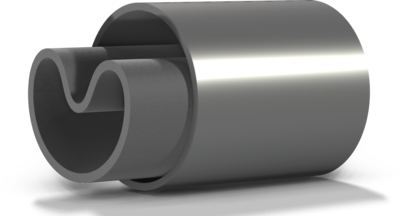
In this example, the Bergstrom–Bischoff material model is used to model the temperature and strain dependent behavior of High Density Polyethylene (HDPE) used, for example, to make liners for damaged pipes in oil and gas applications, or to make type IV hydrogen storage vessels for fuel ... Read More


