
The Application Gallery features COMSOL Multiphysics® tutorial and demo app files pertinent to the electrical, structural, acoustics, fluid, heat, and chemical disciplines. You can use these examples as a starting point for your own simulation work by downloading the tutorial model or demo app file and its accompanying instructions.
Search for tutorials and apps relevant to your area of expertise via the Quick Search feature. Note that many of the examples featured here can also be accessed via the Application Libraries that are built into the COMSOL Multiphysics® software and available from the File menu.
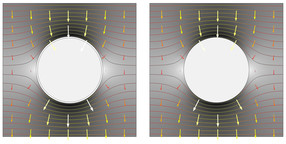
The electric shielding boundary condition is meant to approximate a thin layer of highly conductive material that provides an additional current path tangential to a boundary. This example compares the electric shielding boundary condition to a full-fidelity model and discusses the range ... Read More
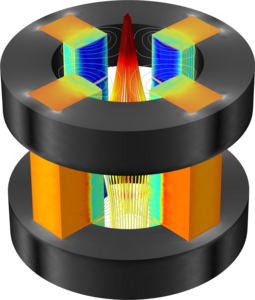
Just like optical lenses focus light, electric and magnetic lenses can focus beams of charged particles. Systems of magnetic quadrupole lenses find a common use in focusing both ion and particle beams in accelerators at nuclear and particle physics centers. This model shows the path of ... Read More
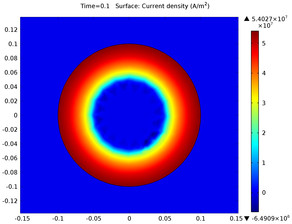
Superconducting materials have zero resistivity up to a certain critical current density, above which the resistivity increases rapidly. To model such a material, this example uses the Magnetic Field Formulation physics interface. The model was based on a suggestion by Dr. Roberto ... Read More
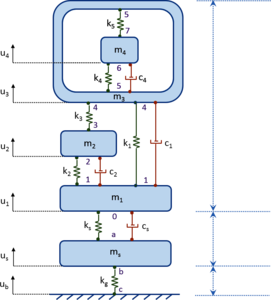
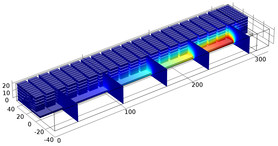
Several mass–spring–damper models have been developed to study the response of a human body where mass, spring, and damper elements represent mass of different body parts, stiffness, and damping properties of various tissues. In this example, a lumped model of a human body having five ... Read More
The elastic cantilever beam is one of the elementary structures used in MEMS designs. This model shows the bending of a cantilever beam under an applied electrostatic load. The model solves the deformation of the beam under an applied voltage. Read More
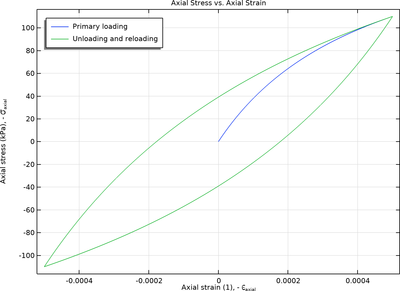
The small strain overlay material model captures the effect of high stiffness at low strain as well as the hysteresis under cyclic loading, which is a common effect for most soils. The formulation allows stiffness degradation with an increase in shear strain, and the full recovery of ... Read More
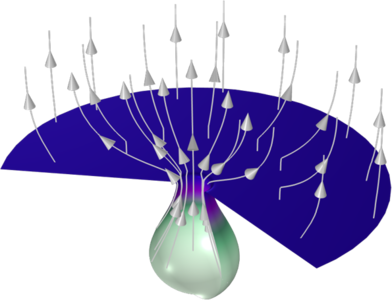
Pitting corrosion is a type of localized corrosion by which local cavities, pits, are formed on an initially smooth metal surface. A pit may be initialized by surface defects, such as an inhomogeneities in composition or shape, or mechanical abuse resulting in a small scratch or dent. ... Read More
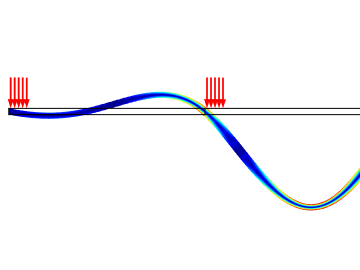
This example shows how to model a load which varies in space and time. A series of load pulses travel along a beam which is supported at equal distances. For some combinations of the traveling speed of the load pulses and the spacing between them, it is possible to excite resonances in ... Read More
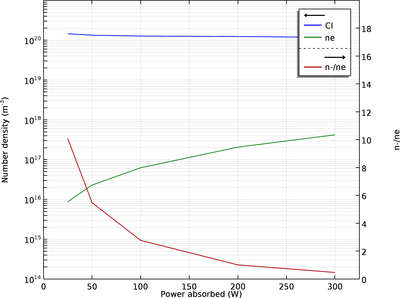
Plasma discharges containing chlorine are commonly used to etch semiconductors and metals in microelectronics fabrication. This tutorial model studies chlorine plasma discharges using a global (volume-averaged) diffusion model. Global diffusion models can run simulations in a fraction ... Read More
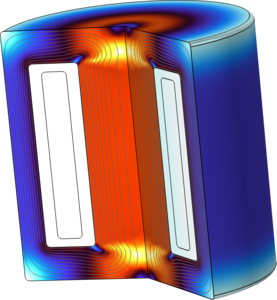
If an inductor's magnetic material is nonlinear, then the inductance depends on the current passing through it. This model consists of an inductor with a nonlinear magnetic core, where the small-signal inductance is simulated as a function of current. The model also investigates how ... Read More


