
The Application Gallery features COMSOL Multiphysics® tutorial and demo app files pertinent to the electrical, structural, acoustics, fluid, heat, and chemical disciplines. You can use these examples as a starting point for your own simulation work by downloading the tutorial model or demo app file and its accompanying instructions.
Search for tutorials and apps relevant to your area of expertise via the Quick Search feature. Note that many of the examples featured here can also be accessed via the Application Libraries that are built into the COMSOL Multiphysics® software and available from the File menu.
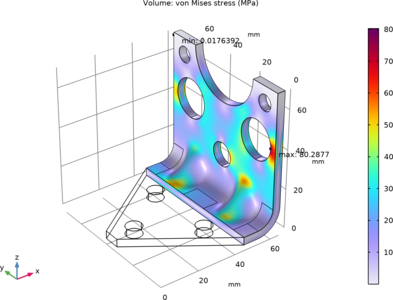
In these tutorial series, we demonstrate how to use the Offset Faces and Transform Faces operations as a way to reparameterize existing holes in a bracket geometry imported from a STEP file. The mass of the bracket is minimized with limits for both the lowest natural frequency, and for ... Read More
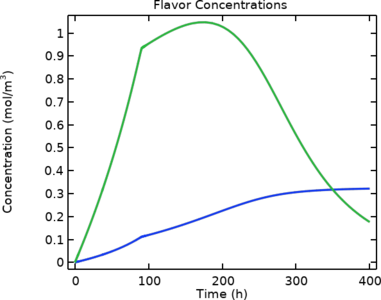
An important step in brewing beer is the fermentation process. Here, alcohol is formed together with various flavor substances from sugars in the presence of yeast. The initial sugar content, temperature, and yeast type dictate how the fermentation proceeds. In this example, the ... Read More
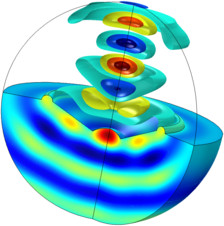
Example of a moving-coil loudspeaker where lumped parameters represent the behavior of the electrical and mechanical components. The Thiele-Small parameters (small-signal parameters) serve as input to the lumped model, which is represented using the Electric Circuit interface. The ... Read More
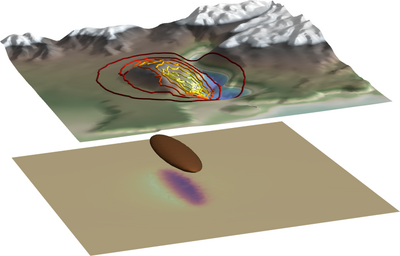
Magnetic prospecting is a geological exploration method that is applicable to certain types of iron ore deposits, in particular those made up of magnetite and hematite. The method consists of measuring the magnetic anomalies (changes in the earth's magnetic field) due to the presence of ... Read More
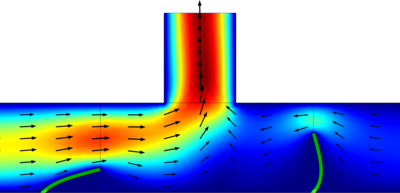
Micropumps are key components of microfluidic systems with applications ranging from biological fluid handling to microelectronic cooling. This model simulates the mechanism of a valveless micropump, that is designed to be effective at low Reynolds numbers, overcoming hydrodynamic ... Read More
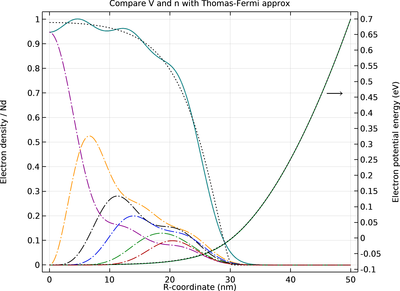
This benchmark model simulates a GaAs nanowire using the self-consistent Schrödinger-Poisson theory to compute the electron density and the confining potential profiles. The predefined Schrödinger-Poisson multiphysics coupling feature is combined with the dedicated Schrödinger-Poisson ... Read More
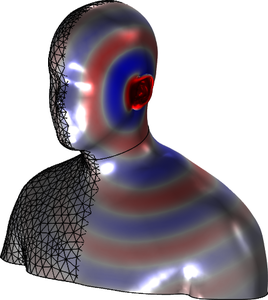
This tutorial model shows how to import a 3D scanned geometry of a human head and torso and compute the head related transfer function (HRTF). The scan is imported as a .stl file and converted into a COMSOL geometry. The HRTF is computed using the reciprocity principle, locating the ... Read More
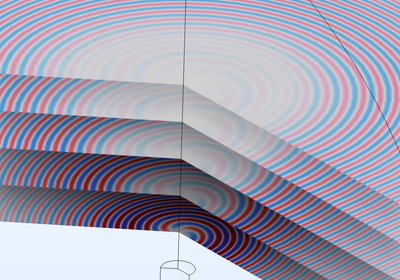
Model of the sound radiation from a circular duct with uniform flow. The convected acoustic problem is described using the linearized potential flow equations, solved in the frequency domain. The acoustic inlet is treated including higher order modes using the Port boundary condition and ... Read More

This model demonstrates how the Free Shape Boundary feature can be used to perform shape optimization on a design found with topology optimization. The model uses the same objective and constraint as the original, which results in a slightly higher stiffness for the same mass. Read More
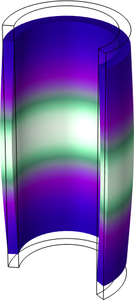
This model calculates the eigenfrequencies and mode shapes of an unconstrained cylinder in axisymmetry. The model is taken from NAFEMS Free Vibration Benchmarks. The eigenfrequencies are compared with the values given in the benchmark report. Three different physics interfaces are ... Read More


