
The Application Gallery features COMSOL Multiphysics® tutorial and demo app files pertinent to the electrical, structural, acoustics, fluid, heat, and chemical disciplines. You can use these examples as a starting point for your own simulation work by downloading the tutorial model or demo app file and its accompanying instructions.
Search for tutorials and apps relevant to your area of expertise via the Quick Search feature. Note that many of the examples featured here can also be accessed via the Application Libraries that are built into the COMSOL Multiphysics® software and available from the File menu.

This example shows a 2D plane stress model of a thin tapered cantilever. Different boundary and load scenarios are examined. It is demonstrated how to apply and how to evaluate different load and constraint groups. Resulting stresses are compared to NAFEMS benchmark values and they are ... Read More
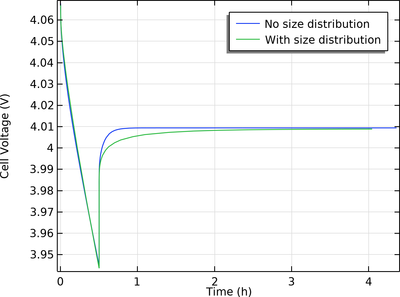
Battery electrodes featuring large heterogeneities in terms of particle sizes may sometimes not be adequately described by homogenized models using one single particle size only. As an alternative to adding multiple instances of the Additional Porous Electrode material node, this ... Read More
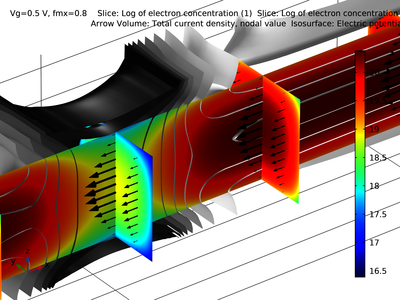
This 3D model of a nanowire MOSFET employs the density-gradient theory to add the effect of quantum confinement to the conventional drift-diffusion formulation, without requiring excessively high computational costs. The oxide layer is simulated explicitly with geometric domains, and ... Read More
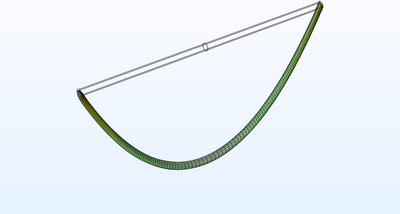
The catenary is the geometrical shape that corresponds to the curve followed by an idealized chain or cable supported at both ends and hanging under its own weight. The viscous catenary problem describes the motion of a cylinder of highly viscous fluid, supported at its ends as it flows ... Read More
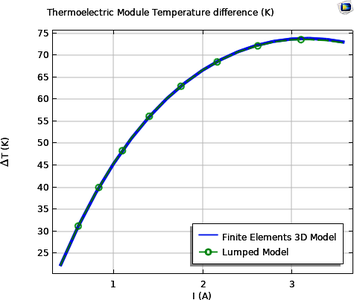
Thermoelectric coolers are widely used for electronics cooling in various application areas, ranging from consumer products to spacecraft design. The thermoelectric modules are a common application of thermoelectricity in cooling engineering. They consist of several thermoelectric legs ... Read More
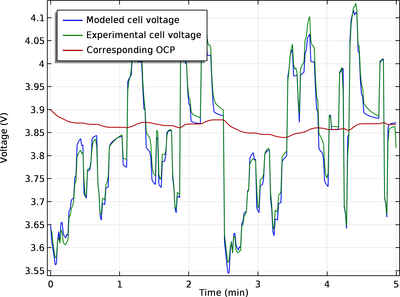
This tutorial uses a “black-box” approach to define a battery model based on a small set of lumped parameters, assuming no knowledge of the internal structure or design of the battery electrodes, or choice of materials. The input to the model is the battery capacity, the initial state ... Read More
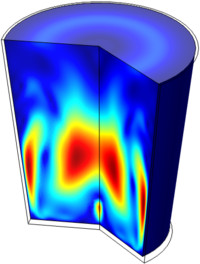
This model treats the free convection and heat transfer of a glass of cold water heated to room temperature. Initially, the glass and the water are at 5 °C and are then put on a table in a room at 25 °C. The nonisothermal flow is coupled to heat transfer using the Heat Transfer module. Read More
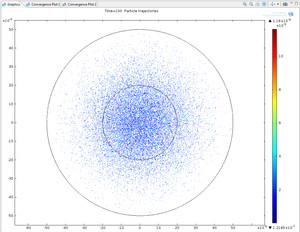
Transport which is purely diffusive in nature can be modeled using a Brownian force. This model shows how to add such a force in the Particle Tracing for Fluid Flow physics interface. Particle diffusion in a fluid is modeled with the diffusion equation and the Particle Tracing for Fluid ... Read More
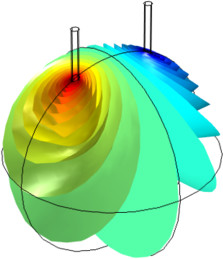
This tutorial example models the currents and the concentration of dissolved metal ions in a battery (corrosion cell) made from an orange and two metal nails. This type of battery is commonly used in chemistry lessons. Instead of an orange, lemons or potatoes can also be used. Read More
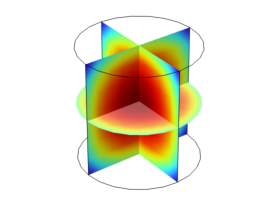
These models use the Discrete Ordinates method (DOM) and P1 approximation to solve a 3D radiative transfer problem in an emitting, absorbing, and linear-anisotropic scattering finite cylindrical medium. Using the S6 quadrature of DOM leads to accurate results, which are needed in ... Read More


