
The Application Gallery features COMSOL Multiphysics® tutorial and demo app files pertinent to the electrical, structural, acoustics, fluid, heat, and chemical disciplines. You can use these examples as a starting point for your own simulation work by downloading the tutorial model or demo app file and its accompanying instructions.
Search for tutorials and apps relevant to your area of expertise via the Quick Search feature. Note that many of the examples featured here can also be accessed via the Application Libraries that are built into the COMSOL Multiphysics® software and available from the File menu.
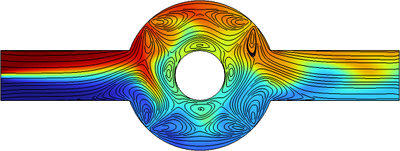
Microlaboratories for biochemical applications often require rapid mixing of different fluid streams. At the microscale, flow is usually highly ordered laminar flow, and the lack of turbulence makes diffusion the primary mechanism for mixing. While diffusional mixing of small ... Read More
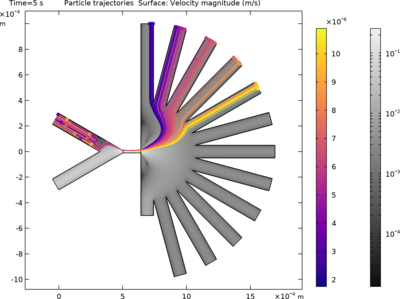
This example simulates the separation of particles based on the size in a microchannel using the method of pinched flow fractionation. The microdevice has two inlets and multiple outlets where the velocity field of liquid flow is calculated using the Laminar Flow interface. Then the ... Read More
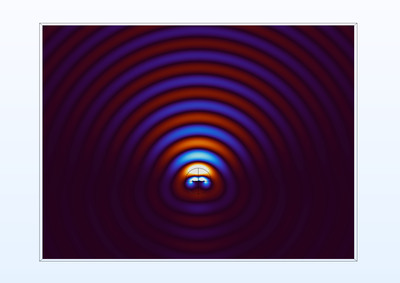
This tutorial model analysis of a microstrip patch antenna shows how to couple the finite element method (FEM) to the boundary element method (BEM) for evaluating the field outside the FEM computational domain. The model computes the S-parameter, near-field distribution, and far-field ... Read More
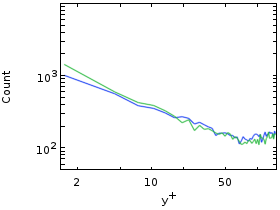
In this benchmark model, solid particles are released in a fully developed turbulent channel flow. The particles are subjected to a drag force that includes contributions from the fluid turbulence, implemented using a Continuous Random Walk (CRW) model. Because the turbulence in the ... Read More
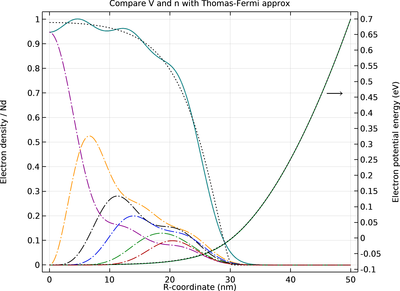
This benchmark model simulates a GaAs nanowire using the self-consistent Schrödinger-Poisson theory to compute the electron density and the confining potential profiles. The predefined Schrödinger-Poisson multiphysics coupling feature is combined with the dedicated Schrödinger-Poisson ... Read More
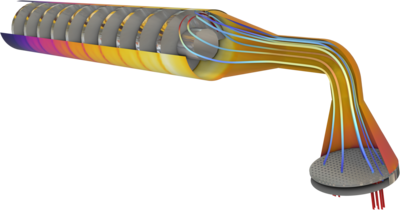
This tutorial example of the pasta extrusion process shows how to simulate the non-isothermal flow of dough in the metering zone of a pasta extruder accounting for the temperature dependent material properties of the hydrated semolina dough. Read More
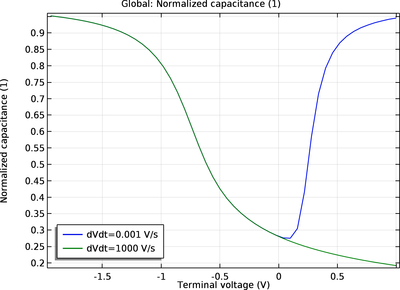
The metal-silicon-oxide (MOS) structure is the fundamental building block for many silicon planar devices. Its capacitance measurements provide a wealth of insight into the working principles of such devices. This tutorial constructs a simple 1D model of a MOS capacitor (MOSCAP). Both ... Read More
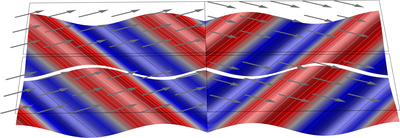
It is possible to engineer the structure of materials such that both the permittivity and permeability are negative. Such materials are realized by engineering a periodic structure with features comparable in scale to the wavelength. It is possible to model both the individual unit cells ... Read More
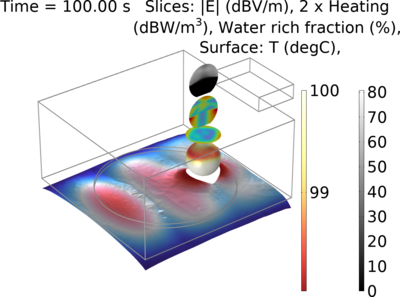
A spherical water-rich load (potato) is placed on the rotating glass tray of a microwave oven some distance from the center of rotation. 1 kW of 2.45 GHz microwave power is applied via a waveguide feed. The plate rotates at 9 degrees per second. The heat transfer model involves the ... Read More
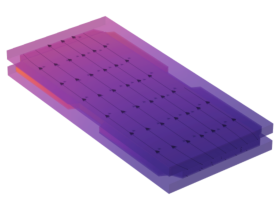
This tutorial models the thermal management of a polymer electrolyte membrane (PEM) fuel cell stack. Operating the stack with a similar temperature profile for all cells is important since an uneven temperature distribution may otherwise result in nonuniform water vapor condensation and ... Read More


