
The Application Gallery features COMSOL Multiphysics® tutorial and demo app files pertinent to the electrical, structural, acoustics, fluid, heat, and chemical disciplines. You can use these examples as a starting point for your own simulation work by downloading the tutorial model or demo app file and its accompanying instructions.
Search for tutorials and apps relevant to your area of expertise via the Quick Search feature. Note that many of the examples featured here can also be accessed via the Application Libraries that are built into the COMSOL Multiphysics® software and available from the File menu.
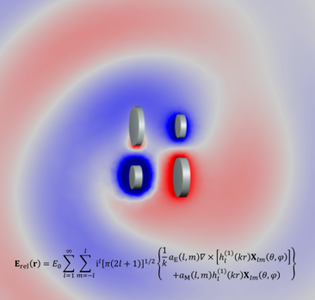
The multipole expansion is a powerful tool for analyzing electromagnetic waves scattered by small objects. In the expansion, the scattered field is represented as a superposition of the fields created by a finite set of point multipoles. Each point multipole is connected to a unique ... Read More
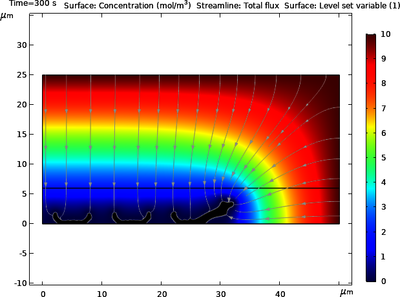
The present model demonstrates diffusion-controlled electrodeposition of copper on microstructured band electrode arrays (MEA). Mass transport by Fickian diffusion of copper ions is solved using the Transport of Diluted Species interface. Dendrite formation as a consequence of diffusion ... Read More
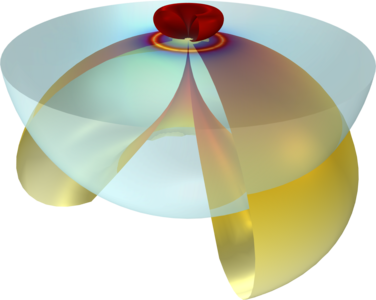
This Application Gallery entry demonstrates how Far-Field radiation can be calculated when a substrate is present. Two approaches are demonstrated. A simplified form that works for two homogeneous domains, and a general approach that can handle multiple, inhomogeneous layers. This ... Read More
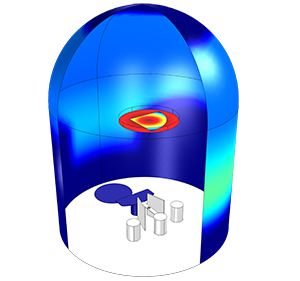
This model shows how to compute the thickness of a thermally evaporated gold film. The thickness of the deposited film is computed both on the walls of the chamber and on the sample. Read More
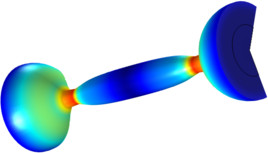
The Marangoni effect results in a slip velocity in the tangential direction on a fluid/fluid interface due to gradients in the surface tension coefficient. When the surface tension coefficient is constant, a two-fluid system may exist in static equilibrium. This is because the surface ... Read More
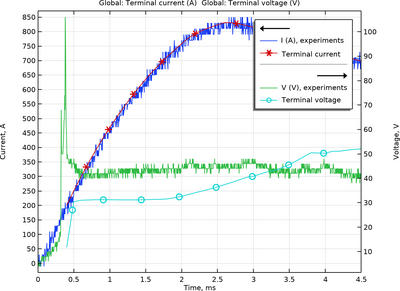
This model presents a 2D simulation of transient arc discharge movement along guided copper rails. While accurately modeling transient arcs typically requires a 3D simulation, the 2D approach offers greater efficiency and remains valuable for initial investigations and demonstration ... Read More
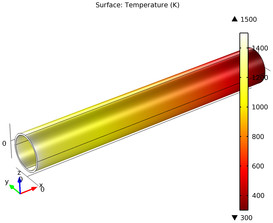
The heat distribution in a hollow pipe, whose ends are held at two different temperatures, is studied. The outside surface is assumed to be thermally isolated and the inner surfaces have radiation boundary conditions. The role of convection in the heat transfer is taken to be ... Read More

These examples demonstrate using the Electrostatics, Boundary Elements interface, introduced in version 5.3 of the COMSOL Multiphysics® software. In the blog post associated with these files, "How to Create Electrostatics Models with Wires, Surfaces, and Solids", we demonstrate the pros ... Read More
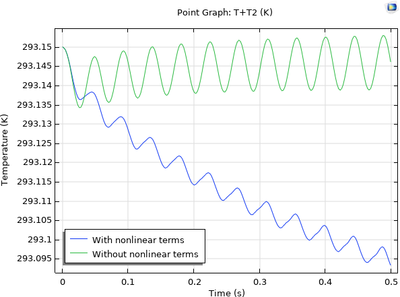
A thermoacoustic engine is a device with no moving parts that can generate acoustic energy from temperature gradients within the engine. It uses the relationship between the movement of oscillating air and the temperature changes in the air compressed and expanded by the acoustic waves. ... Read More
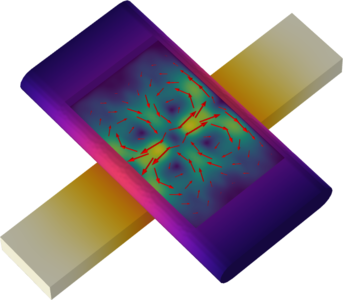
A 3D model of an acoustic trap in a glass capillary actuated by a piezoelectric transducer. The system is actuated by an oscillating electric potential across the piezoelectric transducer inducing mechanical vibrations in the solid and an acoustic pressure field in the fluid. The heat ... Read More


