
The Application Gallery features COMSOL Multiphysics® tutorial and demo app files pertinent to the electrical, structural, acoustics, fluid, heat, and chemical disciplines. You can use these examples as a starting point for your own simulation work by downloading the tutorial model or demo app file and its accompanying instructions.
Search for tutorials and apps relevant to your area of expertise via the Quick Search feature. Note that many of the examples featured here can also be accessed via the Application Libraries that are built into the COMSOL Multiphysics® software and available from the File menu.
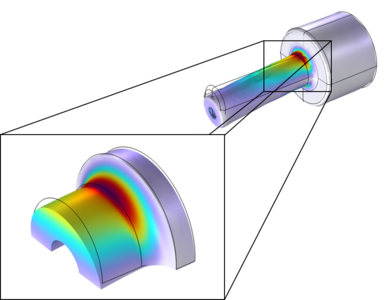
This model shows how to perform a submodeling analysis in order to evaluate structural stress. Using a submodel helps to compute the results in a refined geometry detail while applying loads and constraints in the global model. Read More
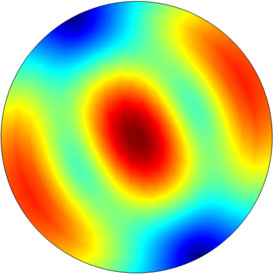
In mode analysis it is usually the primary goal to find a propagation constant. This quantity is often, but not always, real valued; if the analysis involves some lossy part, such as a nonzero conductivity or an open boundary, the eigenvalue is complex. In such situations, the real and ... Read More
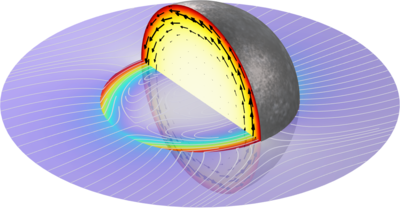
An iron sphere in a magnetic field is an excellent textbook example to demonstrate the effects of a magnetic field interacting with a permeable material. This tutorial series is designed as an introduction to numerically modeling electromagnetic effects with COMSOL. This series ... Read More
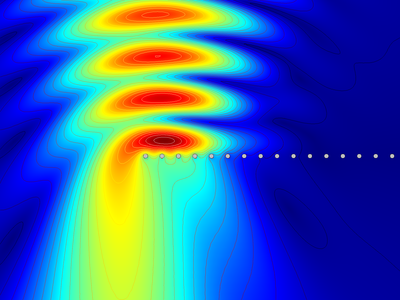
A Gaussian electromagnetic wave is incident on a dense array of very thin wires (or rods). The distance between the rods and, thus, the rod diameter is much smaller than the wavelength. Under these circumstances, the rod array does not function as a diffraction grating (see the Plasmonic ... Read More
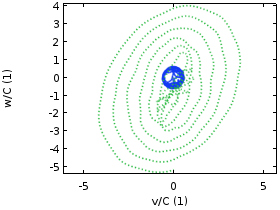
Bearing clearances should be kept minimum to avoid non-synchronous vibration of a rotor. However, a tight clearance reduces the durability of the bearing. This example illustrates modeling of the vibration induced by nonlinear contact for different radial clearances. It is shown that ... Read More
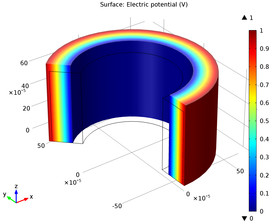
This example involves a static 2D axisymmetric analysis of a piezoelectric actuator using the Piezoelectric Devices physics interface. It models a radially polarized piezoelectric tube, as described by S. Peelamedu and co-authors. An application area where radially polarized tubes are ... Read More
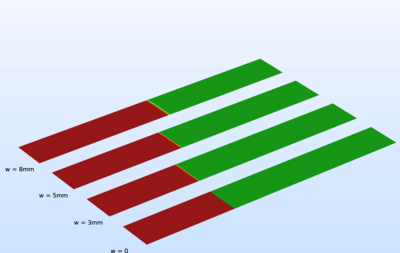
Interfacial failure or delamination in a composite material can be simulated with a cohesive zone model (CZM). A key ingredient of a cohesive zone model is a traction-separation law that describes the softening in the cohesive zone near the delamination tip. This example shows the ... Read More
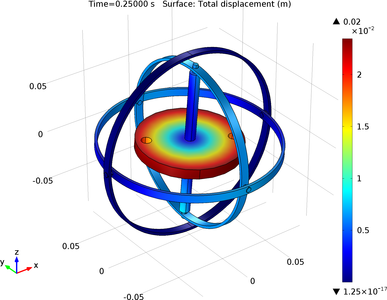
Gyroscopes are used for measuring the orientation or maintaining the stability of airplanes, spacecraft, and submarines vehicles in general. They are also used as sensors in inertial guidance systems. This model demonstrates the modeling of a mechanical gyroscope. It analyzes the ... Read More
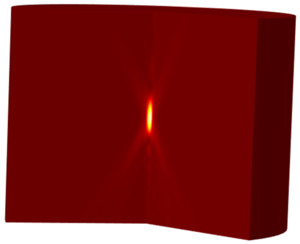
This tutorial shows how to model tissue heating induced by focused ultrasound. First, the stationary acoustic field in the water and the tissue are modeled to obtain the acoustic intensity distribution in the tissue. The absorbed acoustic energy is then calculated and used as the heat ... Read More
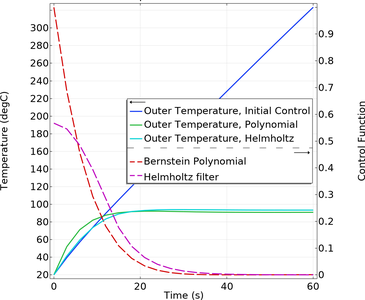
This is an example of optimal control, where the input heating power to a rod is optimized to give a certain temperature on the outside of the rod. This is where the maximum water temperature occurs, while the minimum occurs at the center. Therefore this problem corresponds to the ... Read More


