
The Application Gallery features COMSOL Multiphysics® tutorial and demo app files pertinent to the electrical, structural, acoustics, fluid, heat, and chemical disciplines. You can use these examples as a starting point for your own simulation work by downloading the tutorial model or demo app file and its accompanying instructions.
Search for tutorials and apps relevant to your area of expertise via the Quick Search feature. Note that many of the examples featured here can also be accessed via the Application Libraries that are built into the COMSOL Multiphysics® software and available from the File menu.

In this model the high speed turbulent gas flow in a converging and diverging nozzle is modeled using the High Mach Number Flow interface. The diffuser is transonic in the sense that the flow at the inlet is subsonic, but due to the contraction and the low outlet pressure, the flow ... Read More
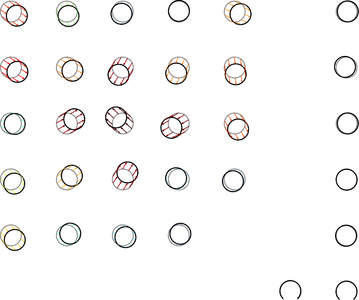
This model builds on the photonic crystal model, where a photonic crystal structure is studied. This structure has a band gap, so only waves within a specific frequency range will propagate through the outlined guide geometry. This model changes the position of the pillars in order to ... Read More
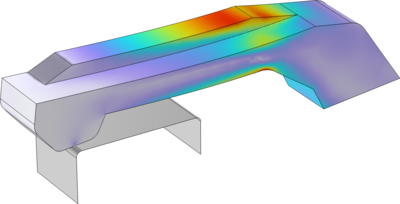
In this example, which serves as a tutorial for contact analyses, the insertion of a snap hook in its groove is studied. A linear elastic material model is used. Read More
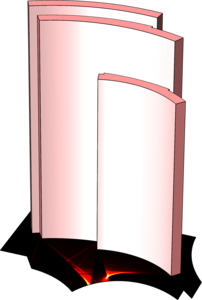
When the Vdara hotel first opened in Las Vegas, visitors relaxing by the pool would experience intense periods of heat at certain times of the day, at certain times of the year. This intense heat was caused by the reflection of solar radiation from the curved, reflective surface on the ... Read More
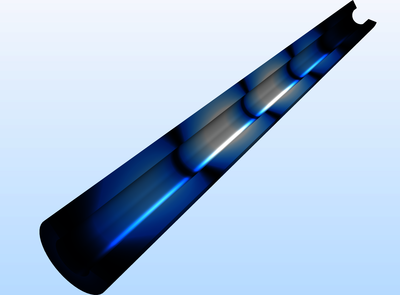
Simulation of Maxwell’s equations in the time domain is useful if the objective of the analysis is to observe a transient phenomenon, to find the time it takes a signal to propagate, or if the materials being modeled are non-linear with respect to the electric or magnetic field strength. ... Read More
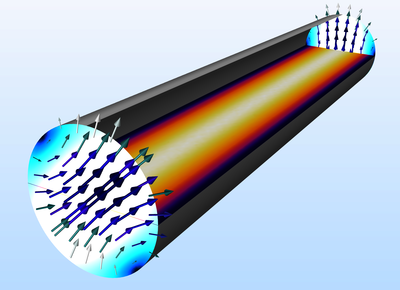
This model of a circular waveguide demonstrates how to use ports with numerical solution of the port modes. It illustrates how to align the polarization of degenerate port modes and in particular how to model and excite the TE11 mode of circular waveguides in 3D. Read More
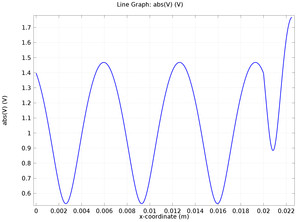
Transmission lines are used when the frequency of the electromagnetic signals is so high that the wave nature of the signals must be taken into account. A consequence of the wave nature is that the signals are reflected if there are abrupt changes of the characteristic impedance along ... Read More
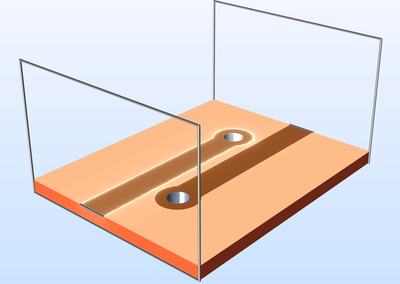
There are multiple ways to excite and terminate transmission lines using different types of port and lumped port features. In this example, transverse electromagnetic (TEM) type ports and a via type lumped port are used to simulate two adjacent microstrip lines. One via end is terminated ... Read More
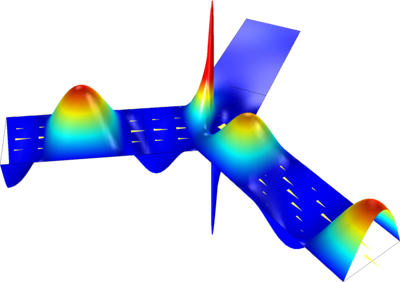
A microwave circulator is a multiport device in which a wave incident on Port 1 is coupled only into Port 2; a wave incident on Port 2 is coupled only into Port 3; and so on. Circulators are used to isolate microwave components, for example, to couple a transmitter and a receiver to a ... Read More
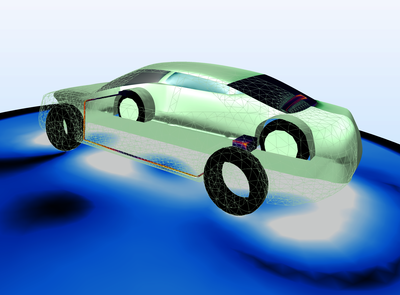
Modern cars have rear-windshield FM antennas to play FM radio. The radiation emitted from an antenna induces an electric current on the outer surface of any cable harnesses in the car, which can have negative effects. This model uses the RF Module to compute the far-field radiation ... Read More


