
The Application Gallery features COMSOL Multiphysics® tutorial and demo app files pertinent to the electrical, structural, acoustics, fluid, heat, and chemical disciplines. You can use these examples as a starting point for your own simulation work by downloading the tutorial model or demo app file and its accompanying instructions.
Search for tutorials and apps relevant to your area of expertise via the Quick Search feature. Note that many of the examples featured here can also be accessed via the Application Libraries that are built into the COMSOL Multiphysics® software and available from the File menu.
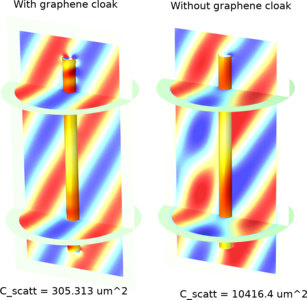
In this model, we introduce a cloaking method using an electrically tuned monolayer of graphene. We will show that when a cylindrical dielectric scatterer is covered in graphene, the scattering cross section is greatly reduced at the designated frequency, making it electromagnetically ... Read More

This model demonstrates how to setup a Time Domain to Frequency FFT study for a distributed Bragg reflector (DBR) structure. The results agree well with the results of a regular Frequency domain study. Read More
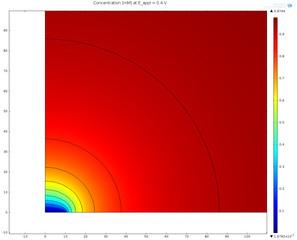
Voltammetry is modeled at a microelectrode of 10um radius. In this common analytical electrochemistry technique, the potential at a working electrode is swept up and down and the current is recorded. The current-voltage waveform ("voltammogram") gives information about the reactivity and ... Read More
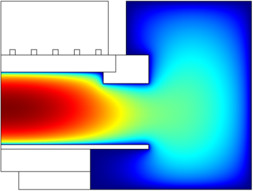
The GEC cell was introduced by NIST in order to provide a standardized platform for experimental and modeling studies of discharges in different laboratories. The plasma is sustained via inductive heating. The Reference Cell operates as an inductively-coupled plasma in this model. This ... Read More
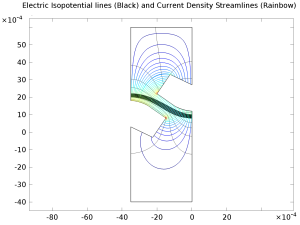
The chlor-alkali membrane process is one of the largest in industrial electrolysis with the production of roughly 40 million metric tons of both chlorine and caustic soda per year. Chlorine is used predominantly for the production of vinyl chloride monomer, which in turn is used for the ... Read More
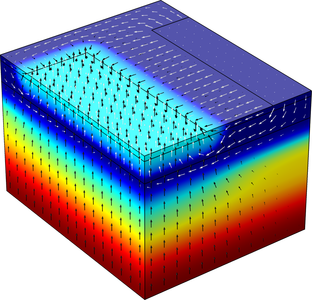
This model shows how to set up a 3D simulation of a n-p-n bipolar transistor. It is a 3D version of the device shown in the Bipolar Transistor model, and demonstrates how to extend semiconductor modeling into 3D using COMSOL Multiphysics. As in the 2D version of this model, the device ... Read More
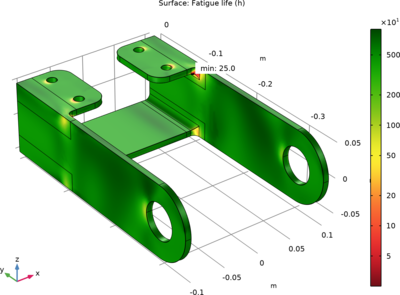
This example shows how to perform a fatigue analysis of a structure subjected to random vibrations. Times to failure using the cycle counting models according to Bendat and Dirlik are compared. Read More
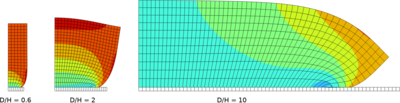
Polymer hydrogels consist of a crosslinked network of long-chained polymers that has imbibed a large number of solvent molecules. Such materials are used in many biomedical applications, such as targeted drug delivery, tissue engineering, and stimuli-sensitive actuators. This benchmark ... Read More

During manufacturing or in-service use, the geometric shape of structural components can deviate from their intended design. For example, a hole may lose its perfectly circular form, making it important to measure and control this deviation. The process of quantifying such deviations is ... Read More
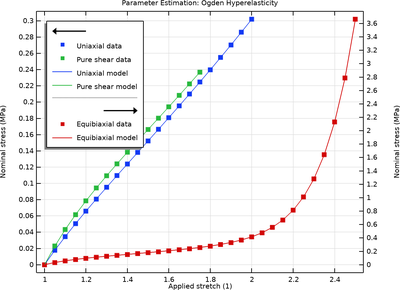
This tutorial model demonstrates how to set up a parameter estimation study for fitting the material parameters of an Ogden hyperelastic model to experimental data. The procedure considers multiple load cases under large deformations, which is often necessary to obtain constitutive ... Read More


