
The Application Gallery features COMSOL Multiphysics® tutorial and demo app files pertinent to the electrical, structural, acoustics, fluid, heat, and chemical disciplines. You can use these examples as a starting point for your own simulation work by downloading the tutorial model or demo app file and its accompanying instructions.
Search for tutorials and apps relevant to your area of expertise via the Quick Search feature. Note that many of the examples featured here can also be accessed via the Application Libraries that are built into the COMSOL Multiphysics® software and available from the File menu.
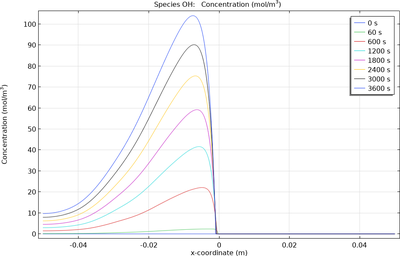
Atmospheric corrosion occurs when metallic structures are exposed to humid air forming a thin electrolyte film in the range of up to a few hundred micrometers. The model presented here accounts for charge transport as well mass transport involving 10 species and 6 homogeneous ... Read More
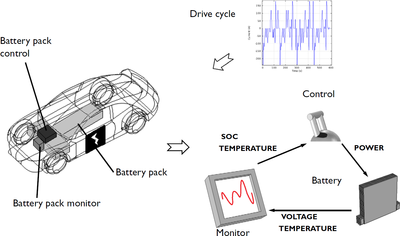
This application shows how a battery cell exposed to a hybrid electric vehicle drive cycle can be investigated with the Lithium-Ion Battery interface in COMSOL. This model predicts the battery behavior to make comparisons of the monitored properties. They can be used to understand the ... Read More
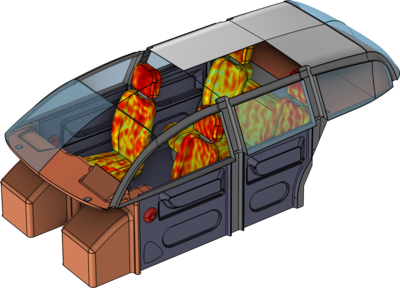
This tutorial shows the analysis of a car cabin in order to study the performance of a sound system in the low to mid frequency range. The cabin is of a typical sedan interior, that is, the inside of a hard-top family car. The model studies the frequency response at the location of a ... Read More
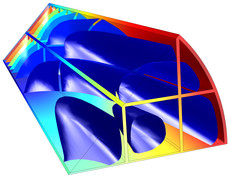
This suite of examples illustrate the modeling of selective NO reduction, that occurs as flue gases pass through the channels of a monolithic reactor in the exhaust system of a motored vehicle. The simulations are aimed at finding the optimal dosing of NH3, the reactant that serves as ... Read More

The electrodes of a lithium-ion battery are porous and consist of an active solid electrode material, a binder, and pores filled with a liquid electrolyte. Expansion of the active material due to lithium intercalation changes the volume fraction of electrolyte-filled pores in the ... Read More
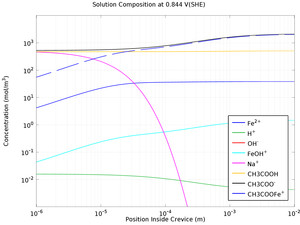
Mass transport limitations within thin crevices can often result in the local electrochemistry to differ significantly between the crevice opening (mouth) and end (tip), and as a result of the differences in local chemistry, corrosion may occur. This example models crevice corrosion of ... Read More
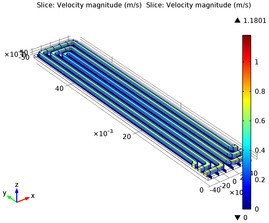
This example models the flow and mass transport in the channels and the gas diffusion layer (GDL) of a polymer electrolyte fuel cell. The cathode electrode reaction is modeled as a boundary condition, where the local current density depends on the overpotential and the local oxygen ... Read More
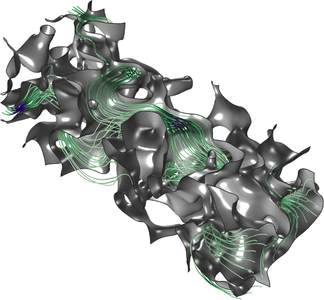
Modeling flow through realistic porous structures is difficult due to the complexity of the structure itself. Often, resolving the flow field in detail is not feasible; therefore, a macroscopic description of the pore scale structure, which utilize averaged quantities such as porosity ... Read More
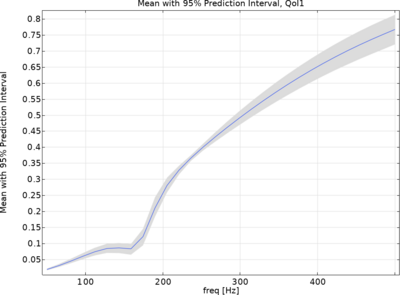
It can in many cases be difficult to get accurate material properties for porous materials. Measuring the properties to high precision can involve lengthy measurements using different techniques. It can therefore be interesting to understand how uncertainties in different material ... Read More
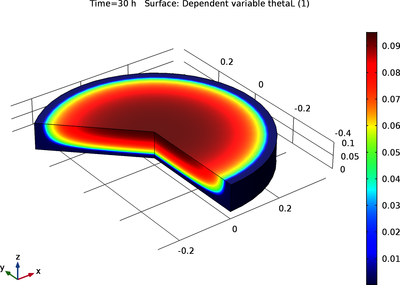
Vacuum drying is a chemical process frequently used in the pharmaceutical and food industries to remove water or an organic solvent from a wet powder. When designing a vacuum drying system, engineers aim to minimize the drying time while maintaining high quality in the product. This ... Read More


