
The Application Gallery features COMSOL Multiphysics® tutorial and demo app files pertinent to the electrical, structural, acoustics, fluid, heat, and chemical disciplines. You can use these examples as a starting point for your own simulation work by downloading the tutorial model or demo app file and its accompanying instructions.
Search for tutorials and apps relevant to your area of expertise via the Quick Search feature. Note that many of the examples featured here can also be accessed via the Application Libraries that are built into the COMSOL Multiphysics® software and available from the File menu.

This example illustrates the principle of electrochemical polishing. The simplified 2D model geometry consists of two electrodes and an intermediate electrolyte domain The positive electrode has a protrusion, representing a surface defect. The purpose of the model is to examine how this ... Read More
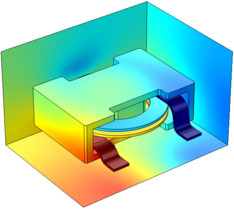
Power inductors are a central part of many low-frequency power applications. They are, for example, used in the switched power supply for the motherboard and all other components in a computer. Computer simulations are necessary in the design of such inductors. This model calculates the ... Read More

The model demonstrates how to compute the induced voltage of a wire loop inside an airplane under different electromagnetic shielding conditions. Read More
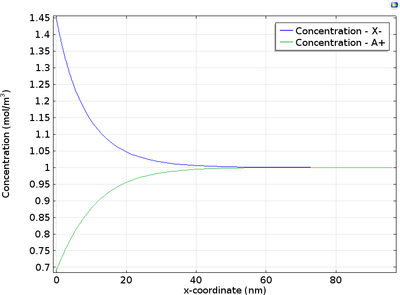
At the electrode-electrolyte interface, there is a thin layer of space charge in a diffuse double layer. This may be of interest when modeling devices such as electrochemical capacitors and nanoelectrodes. This tutorial example shows how to couple the Nernst-Planck equations to the ... Read More
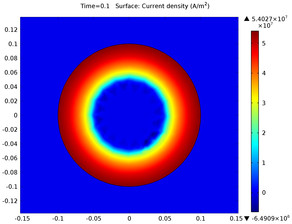
Superconducting materials have zero resistivity up to a certain critical current density, above which the resistivity increases rapidly. To model such a material, this example uses the Magnetic Field Formulation physics interface. The model was based on a suggestion by Dr. Roberto ... Read More
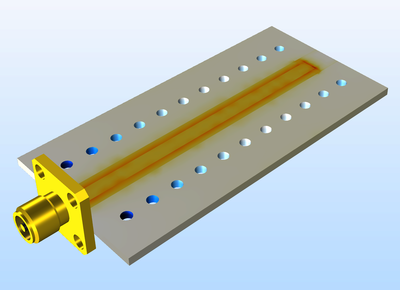
SMA connectors are popularly used on printed circuit boards (PCB) for testing. This model shows how to excite an SMA connector on a microwave substrate and how to terminate a grounded coplanar waveguide (GCPW) with 50 ohm using a lumped port and an air-bridge. Read More
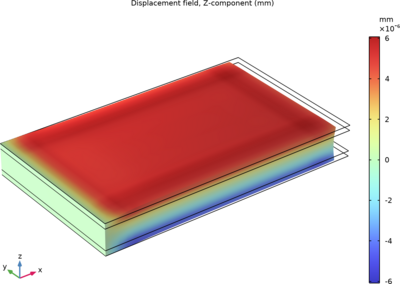
This tutorial is intended as a simple example showing how to model piezoelectric devices using the layered shell functionality. Two cases of material orientation are investigated. In the first case, the pole axis is normal to the shell surface, which results in a change in thickness of ... Read More
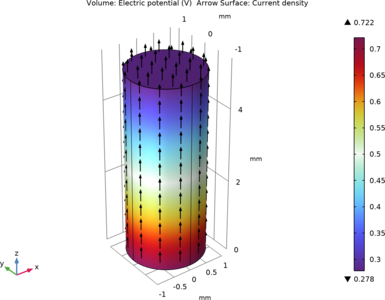
HowTo: Using the EC External I-Terminal The External Couplings in the CIR interface has two flavors that can be used. External I vs. U and External I-terminal. The former has two nodes (it represents a differential external voltage measurement) and when coupling to an EC Terminal ... Read More
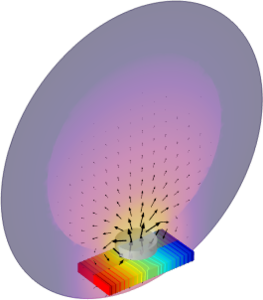
A Hall effect sensor is a semiconductive material with an anisotropic conductivity that is a function of the magnetic field. A magnet, mounted on a wheel, is rotated around nearby the sensor and the variation in the electric potential across the sensor is modeled. For complete ... Read More
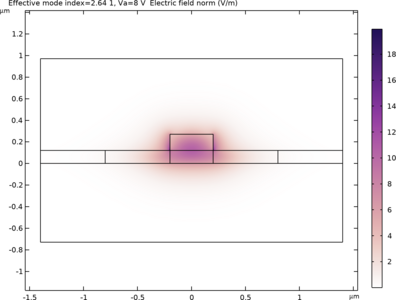
This tutorial demonstrates how to model a Silicon-on-Insulator (SoI) Modulator – a well-known optics device configuration that takes advantage of the free-carrier plasma dispersion effect and allows for the electrical control of the optical waveguide properties. The simulation couples ... Read More


