
The Application Gallery features COMSOL Multiphysics® tutorial and demo app files pertinent to the electrical, structural, acoustics, fluid, heat, and chemical disciplines. You can use these examples as a starting point for your own simulation work by downloading the tutorial model or demo app file and its accompanying instructions.
Search for tutorials and apps relevant to your area of expertise via the Quick Search feature. Note that many of the examples featured here can also be accessed via the Application Libraries that are built into the COMSOL Multiphysics® software and available from the File menu.
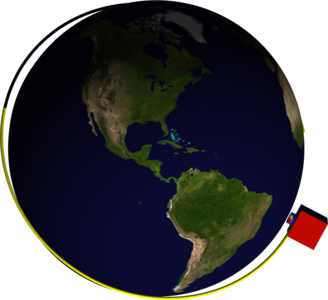
This model is an introduction to defining and verifying a satellite orbit, and computing the solar, albedo, and Earth infrared thermal loads. A 1U CubeSat is in a circular orbit at 400km altitude, inclination of 50°, and longitude of ascending node of 0°. The satellite is rotating slowly ... Read More
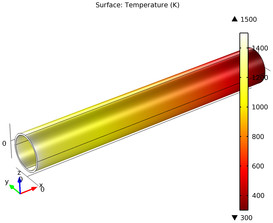
The heat distribution in a hollow pipe, whose ends are held at two different temperatures, is studied. The outside surface is assumed to be thermally isolated and the inner surfaces have radiation boundary conditions. The role of convection in the heat transfer is taken to be ... Read More
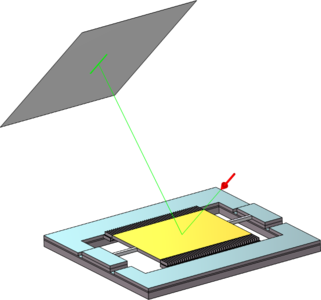
MEMS scanning mirrors are a type of MEMS device that realizes optical path control by controlling mirror torsion through a microdriver. The torsion can be single axis or double axis. MEMS scanning mirrors are widely used in laser projection, laser radar, laser processing, and other ... Read More
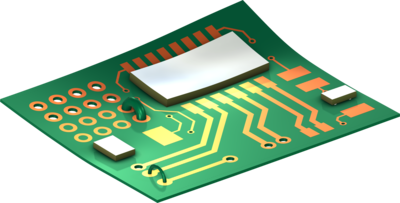
Reflow soldering is an important process in IC packaging. In reflow soldering, the solder materials are melted to create joints between electrical components and the PCBs for structural and electrical connections. This model demonstrates the process of attaching chips to a PCB by reflow ... Read More
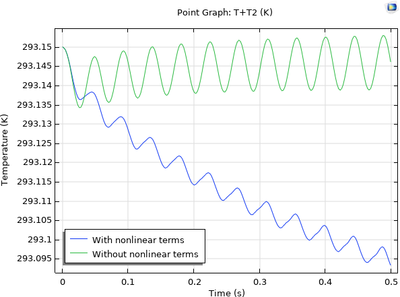
A thermoacoustic engine is a device with no moving parts that can generate acoustic energy from temperature gradients within the engine. It uses the relationship between the movement of oscillating air and the temperature changes in the air compressed and expanded by the acoustic waves. ... Read More
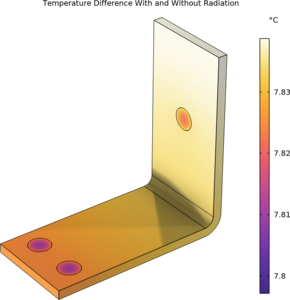
This model computes an electromagnetic-heated busbar with surface-to-surface radiation and compares the results with the busbar model without radiation. The surface emissivity of copper is varied between 0.1 (blank material), 0.3 (partially oxidized), and 0.7 (heavily oxidized). A more ... Read More
A time-varying current induces a time-varying magnetic field. The magnetic field induces currents in neighboring conductors. The induced currents are called eddy currents. In this model, the phenomenon is illustrated by a time-harmonic field simulation as well as a transient analysis, ... Read More

The models here showcase several use cases of the Circuit Extractor add-in, which is able to generate electric circuits from solved physics. A more detailed description of this tutorial model can be found in the blog post "Extracting Electrical Circuits from Electromagnetics ... Read More
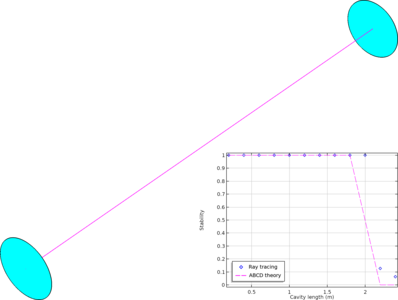
In this model, two concave mirrors are placed at a distance and a ray is released from a point inside the cavity. Then the ray is traced for a predefined time period that is sufficiently long. Ray tracing continues until the predefined computation time has passed if the laser cavity is ... Read More
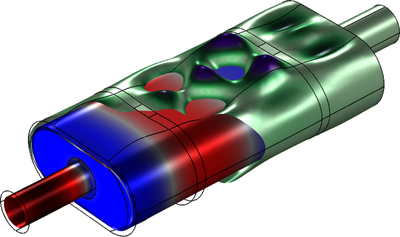
This model describes the pressure wave propagation in a muffler for an internal combustion engine. The purpose of the model is to show how to analyze both inductive and resistive damping in pressure acoustics as well as coupling the fluid to the surrounding elastic shell structure of the ... Read More


