
The Application Gallery features COMSOL Multiphysics® tutorial and demo app files pertinent to the electrical, structural, acoustics, fluid, heat, and chemical disciplines. You can use these examples as a starting point for your own simulation work by downloading the tutorial model or demo app file and its accompanying instructions.
Search for tutorials and apps relevant to your area of expertise via the Quick Search feature. Note that many of the examples featured here can also be accessed via the Application Libraries that are built into the COMSOL Multiphysics® software and available from the File menu.
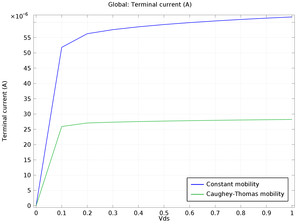
With an increase in the parallel component of the applied field, carriers can gain energies above the ambient thermal energy and be able to transfer energy gained by the field to the lattice by optical phonon emission. The latter effect leads to a saturation of the carriers mobility. The ... Read More
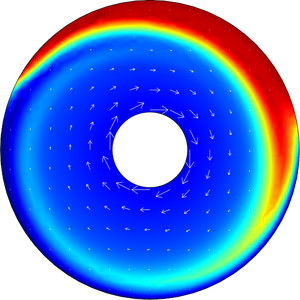
Liquid-solid mixtures (suspensions) are important in a variety of industrial fields, such as oil and gas refinement, paper manufacturing, food processing, slurry transport, and wastewater treatment. Several different modeling approaches have been developed by the CFD community, ranging ... Read More
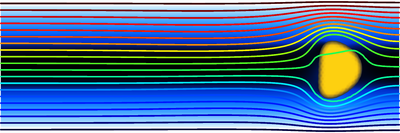
Applying an electric field across a suspension of immiscible liquids may stimulate droplets of the same phase to coalesce. The method known as electrocoalescence has important applications, for instance, in the separation of oil from water. To model electrocoalescence, you need to solve ... Read More
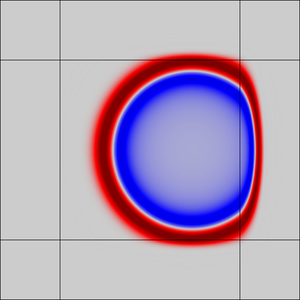
This tutorial simulates a standard test and benchmark model for nonreflecting conditions and sponge layers for linearized Euler-like systems. It involves the propagation of a transient Gaussian pulse in a 2D uniform flow. The Convected Wave Equation, Time Explicit interface solves the ... Read More
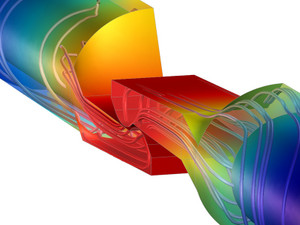
This model illustrates how to implement a multiphysics contact. It models the thermal and electrical behavior of two contacting parts of a switch. The electrical current and the heat flow from one part to the other only through the contact surface. The contact switch device has a ... Read More
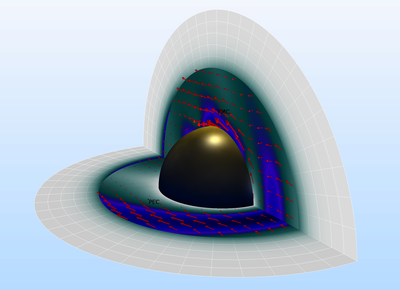
A classic benchmark problem in computational electromagnetics is to solve for the radar cross section (RCS) of a sphere in free space illuminated by a plane wave. This model solves for the RCS of a metallic sphere that has a very high conductivity, which can be treated as a material with ... Read More
This tutorial shows how you can use the Electromechanics interface in COMSOL's MEMS Module to model Electrostriction. Electrostrictive materials (e.g. PMN-PT) exhibit nonlinear strain as a function of electric field. This 2D axisymmetry model uses a parametric sweep of voltage to ... Read More
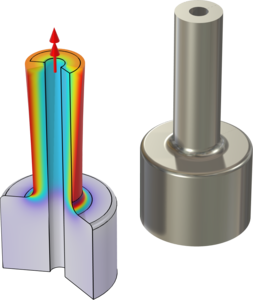
Including circumferential displacements in a 2D axisymmetric Solid Mechanics interface allows to compute twist and bending deformations. This model determines stress concentration factors for a hollow shaft for load cases of axial extension, torsion, as well as bending, using a ... Read More
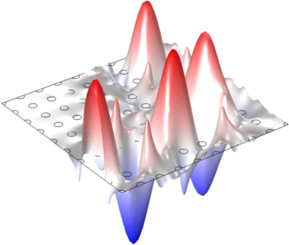
Photonic crystal devices are periodic structures of alternating layers of materials with different refractive indices. Waveguides that are confined inside of a photonic crystal can have very sharp low-loss bends, which may enable an increase in integration density of several orders of ... Read More

During the design of a building, environmental issues have gained considerable influence in the entire project. One of the first concerns is to improve thermal performances. In this process, simulation software are key tools to model thermal losses and performances in the building. The ... Read More


