
The Application Gallery features COMSOL Multiphysics® tutorial and demo app files pertinent to the electrical, structural, acoustics, fluid, heat, and chemical disciplines. You can use these examples as a starting point for your own simulation work by downloading the tutorial model or demo app file and its accompanying instructions.
Search for tutorials and apps relevant to your area of expertise via the Quick Search feature. Note that many of the examples featured here can also be accessed via the Application Libraries that are built into the COMSOL Multiphysics® software and available from the File menu.

A plane TE-polarized electromagnetic wave is incident on a gold nanoparticle on a dielectric substrate. The absorption and scattering cross-sections of the particle are computed for a few different polar and azimuthal angles of incidence. The model first computes a background field from ... Read More
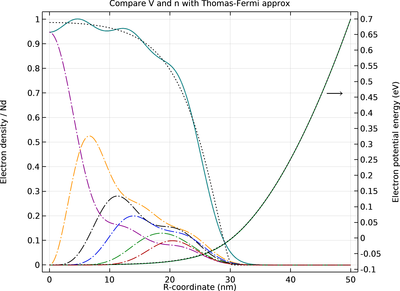
This benchmark model simulates a GaAs nanowire using the self-consistent Schrödinger-Poisson theory to compute the electron density and the confining potential profiles. The predefined Schrödinger-Poisson multiphysics coupling feature is combined with the dedicated Schrödinger-Poisson ... Read More
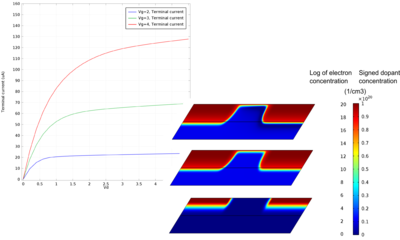
This model calculates the DC characteristics of a simple MOSFET. The drain current versus gate voltage characteristics are first computed in order to determine the threshold voltage for the device. Then the drain current vs drain voltage characteristics are computed for several gate ... Read More
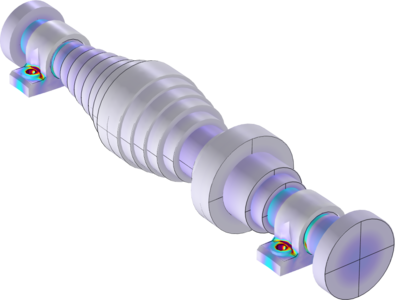
Hydrodynamic bearings generate heat due to the viscous losses in the lubricant. As a result, the temperature of the rotor increases causing deformation and thermal stresses in both the rotor and the bearing housing. This example shows how to model different physical phenomena that are ... Read More
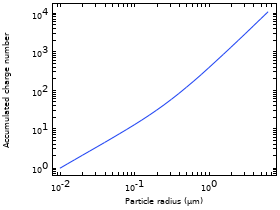
This model computes the fluid flow, charge transport and electric potential in an electrostatic precipitator. Based on the resulting fields, particles of different diameter are fed into the device and the transmission probability is computed. As expected, the separation efficiency shows ... Read More
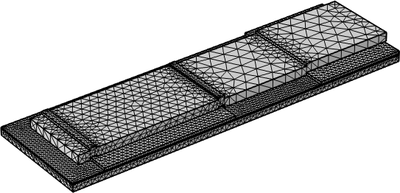
This tutorial demonstrates how to build the geometry for the 3D biased resonator from GDS file using the ECAD Import Module and the Design Module. The procedure emulates semiconductor and MEMS fabrication processes to build 3D geometry more efficiently and is more intuitive for those ... Read More
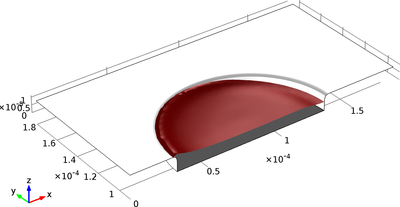
This model simulates the shape evolution of a microconnector bump over time as copper deposits on an electrode surface. Transport of cupric ions in the electrolyte occurs by convection and diffusion. The electrode kinetics are described by a concentration dependent Butler-Volmer ... Read More
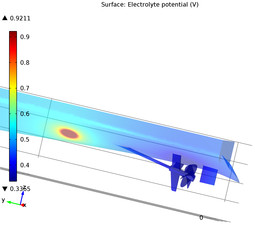
Impressed current cathodic protection is a commonly employed strategy to mitigate the ship hull corrosion where an external current is applied to the hull surface, polarizing it to a lower potential. In this model, the effect of propeller coating on the current demand is demonstrated. Read More
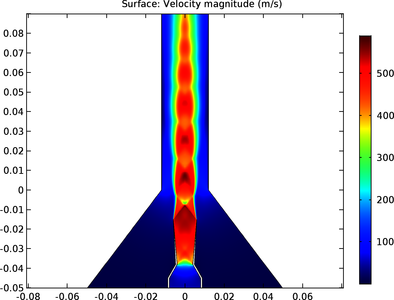
In this study, the compressible turbulent flow through a supersonic ejector is modeled using the High Mach Number Flow interface in the CFD Module. Ejectors are simple mechanical components used for a wide range of applications, including industrial refrigeration, vacuum generation, gas ... Read More
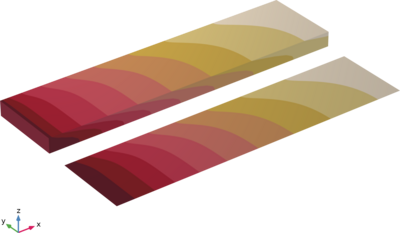
This application shows how mass transfer out from a thin 3D domain can be approximated using a 2D component with the domain feature Out-of-Plane Flux. This feature is useful when the concentration gradient in the out-of-plane direction (along the thickness) is small, and decreasing the ... Read More


