
The Application Gallery features COMSOL Multiphysics® tutorial and demo app files pertinent to the electrical, structural, acoustics, fluid, heat, and chemical disciplines. You can use these examples as a starting point for your own simulation work by downloading the tutorial model or demo app file and its accompanying instructions.
Search for tutorials and apps relevant to your area of expertise via the Quick Search feature. Note that many of the examples featured here can also be accessed via the Application Libraries that are built into the COMSOL Multiphysics® software and available from the File menu.
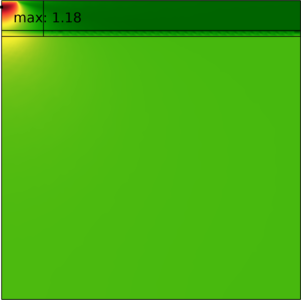
A standing contact fatigue test is a procedure used for testing crack growth on the subsurface level. In such a test, a spherical object is pressed against the tested materials and cycled between a high and low compressive load. No translational movement between the two occurs. After a ... Read More
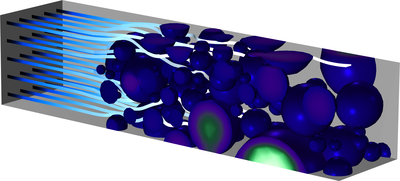
In this example, a heterogeneous NMC (Nickel-Manganese-Cobalt) electrode structure is generated from tomography data using a Model Method. Time-dependent discharge and electrochemical impedance spectroscopy (EIS) simulations are then made on the full 3D geometry. A solid mechanics ... Read More
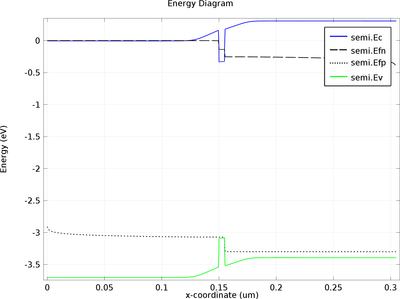
This model simulates a GaN based light emitting diode. The emission intensity, spectrum, and quantum efficiency are calculated as a function of the driving current. Direct radiative recombination across the band gap is modeled, as well as non-radiative Auger and trap-assisted ... Read More
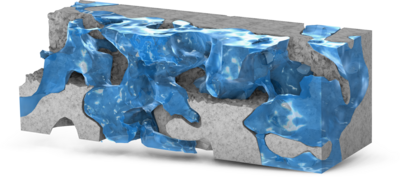
Digital Rock technology utilizes high-resolution imaging techniques, such as SEM and X-ray CT, to characterize the pore structures of rock cores. This approach enables pore-scale modeling of reservoir rocks, offering valuable insights into pore morphology, connectivity, and fluid ... Read More
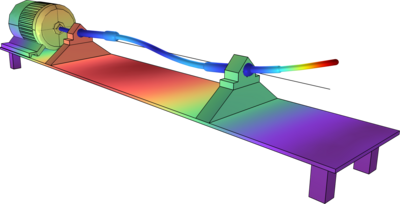
Active magnetic bearings are often used for controlling the vibration level in mechanical systems. In this example, a motor driven rotor system in which the speed of the system is gradually increased is considered. The system vibrates due to existing imbalances. As the rotor speed ... Read More
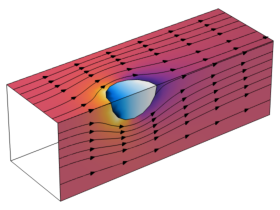
This model demonstrates the use of the Heat and Moisture Flow features for the simulation of superheated steam drying of a wood particle. A nonequilibrium formulation is used to compute the transport of the liquid water and vapor phases in the wood particle. Reference: Le, K. H., ... Read More
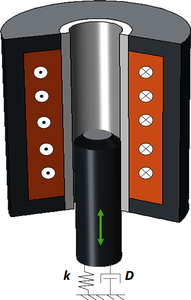
This is a transient model of an electromagnetic plunger consisting of a magnetic core, nonmagnetic guider, multi-turn coil, and magnetic plunger attached to the spring and damper at the far end. The electromagnetic force on the plunger due to the transient current in the coil is ... Read More

This presentation and series of models show how to use the Deformed Mesh interfaces to model small and large translations and rotations of objects. A more detailed description of these models can be seen in the blog post Model Translational Motion with the Deformed Mesh Interfaces and ... Read More
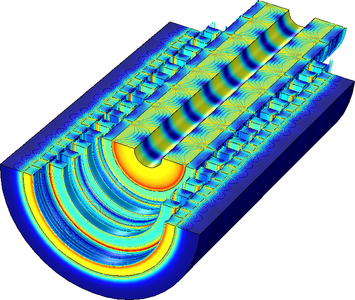
In this model, a linear magnetic gear system with a gear ratio of 11:4 is modeled. The liner magnetic gear is assumed to be infinitely long with the modular structure that is repeating on either side. Only a single modular section is modeled by using the customized linear periodic ... Read More
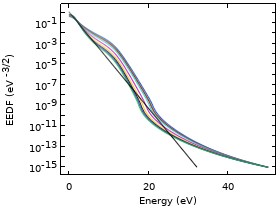
In this example, a hydrogen plasma reactor at moderate pressure is studied using a global model. The heavy species heat equation is included. In the first part of the study, a Maxwellian electron energy distribution function is used. In the second part, the global model is solved self ... Read More


