
The Application Gallery features COMSOL Multiphysics® tutorial and demo app files pertinent to the electrical, structural, acoustics, fluid, heat, and chemical disciplines. You can use these examples as a starting point for your own simulation work by downloading the tutorial model or demo app file and its accompanying instructions.
Search for tutorials and apps relevant to your area of expertise via the Quick Search feature. Note that many of the examples featured here can also be accessed via the Application Libraries that are built into the COMSOL Multiphysics® software and available from the File menu.

The model shows how to calibrate the probability distribution of the Young's modulus and Poisson ratio based on a tensile test. The test measures the tensile force and the radial displacement for different values of the prescribed displacement. The model is based on synthetic data ... Read More
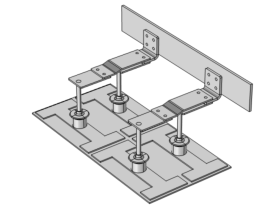
This tutorial series describes in two different ways how to organize a more complex geometry. Read More
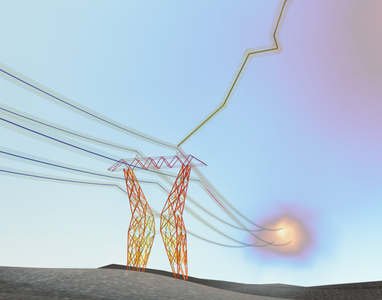
This model demonstrates the analysis of lightning surges on high voltage transmission line towers. Lightning carrying a current of 10 kA struck one of the tower's shielded wires. The induced voltage at the three-phase conductors are computed. Some highlights of this model: Perform ... Read More
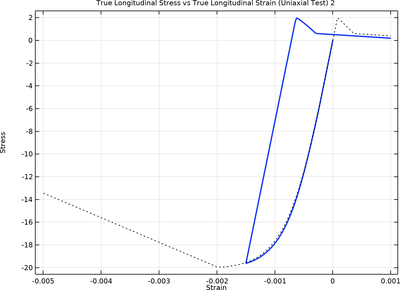
This example shows the behavior of the coupled damage-plasticity material model for concrete when subjected to different loading conditions. Read More
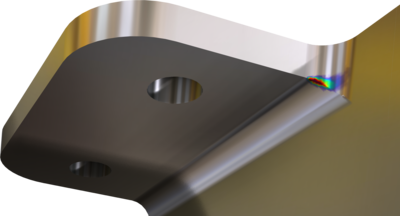
This example shows how to perform a fatigue analysis of a structure subjected to harmonic vibrations. The loading is applied at the attachments of the structure, and a frequency sweep is performed to compute the fatigue usage. Read More
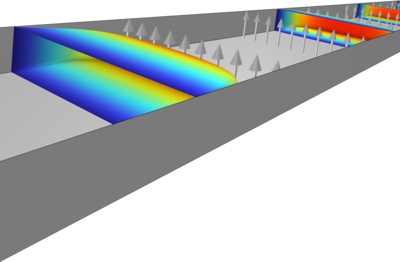
In nuclear fusion reactors, the conducting fluid, such as the fusion plasma and the liquid metal in the reactor blanket, will interact with the background magnetic field. This phenomenon is referred to as magnetohydrodynamics (MHD). The electromagnetic field and fluid flow are fully ... Read More
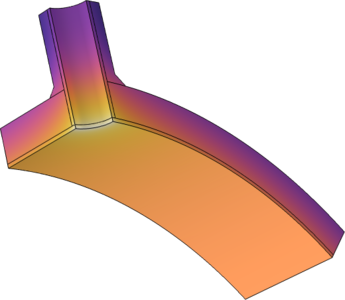
This example demonstrates how to use temperature dependent materials within the Nonlinear Structural Materials Module. A large container holds pressurized hot water. Several pipes are attached to the pressure vessel. Those pipes can rapidly transfer cold water in case of an emergency ... Read More
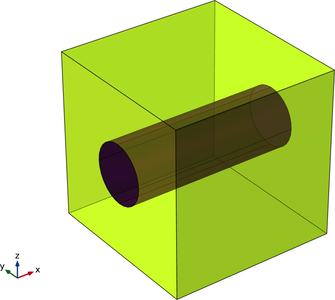
In this example, a simplified micromechanical model of a unit cell with periodic boundary conditions is analyzed. The homogenized elastic and thermal properties of a composite material are computed based on individual properties of fiber and matrix. A comparison of numerical values are ... Read More

This example shows how to model prestressed bolts. The bolt geometry is taken from the Part Libraries. For comparison, one of the bolts is modeled using a thread contact formulation, whereas the other bolt is connected to the bolt hole by a pure continuity condition. The reduced ... Read More
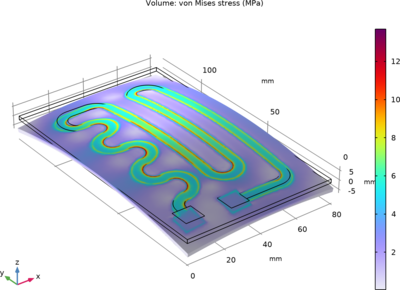
Small heating circuits find use in many applications. For example, in manufacturing processes, they heat up reactive fluids. The device in this tutorial example consists of an electrically resistive layer deposited on a glass plate. The layer results in Joule heating when a voltage is ... Read More


