
The Application Gallery features COMSOL Multiphysics® tutorial and demo app files pertinent to the electrical, structural, acoustics, fluid, heat, and chemical disciplines. You can use these examples as a starting point for your own simulation work by downloading the tutorial model or demo app file and its accompanying instructions.
Search for tutorials and apps relevant to your area of expertise via the Quick Search feature. Note that many of the examples featured here can also be accessed via the Application Libraries that are built into the COMSOL Multiphysics® software and available from the File menu.
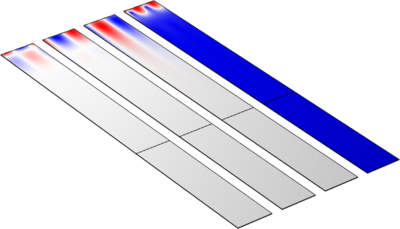
In the surface acoustic waves industry different crystal cuts of piezoelectric materials are used, e.g. 128ᵒ YX LiNbO3, AT&ST quartz, 42ᵒ YX LiTaO3, etc. Direct data isn’t available for all cuts. The standard approach is to use the so-called Euler angle rotation. COMSOL supports it ... Read More
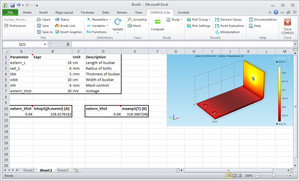
Tutorial model that demonstrates how to work with COMSOL models in Excel, including loading and saving files, updating model parameters, solving, and retrieving results. Read More

Crimping is the plastic deformation process used to form an electrical joint between a stranded conductor and a terminal. The process involves complex multi-surface contact, including self-contact, as the terminal sleeve is plastically deformed around the wire strands. This example ... Read More
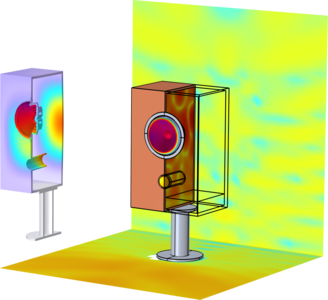
This model shows a full vibroacoustic analysis of a loudspeaker including driver, cabinet, and stand. It lets you apply a nominal driving voltage and extract the resulting sound pressure level in the cabinet and in the outside room, as well as the deformation of the cabinet and driver, ... Read More

In a cooling system, a microelectronic component has been identified as the critical link. Since the power is repeatedly switched on and off, the component is subjected to thermal cycling. As a results a crack grows through a solder joint and disconnects the chip from the printed circuit ... Read More
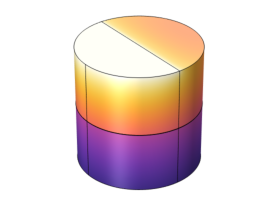
This example shows how to set up multiple sandwiched thin layers with different thermal conductivities in two different ways. First, the composite is modeled as a 3D object. In the second approach, the thin domains are modeled with thermal resistors in the Lumped Thermal System ... Read More
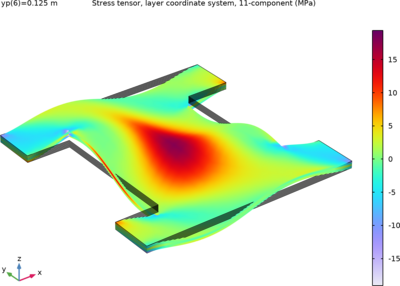
Composite materials are often used in structural applications because their properties, such as stiffness and strength, can be tailored to meet specific requirements. This makes them attractive alternatives to traditional engineering materials. Composites are also used in applications ... Read More
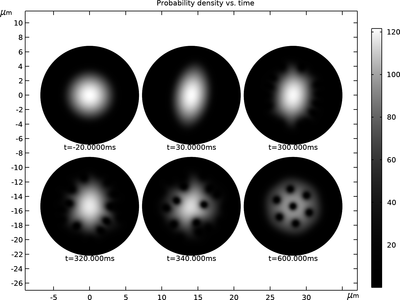
This tutorial model solves the Gross–Pitaevskii Equation for the vortex lattice formation in a rotating Bose–Einstein condensate bound by a harmonic trap. The equation is essentially a nonlinear single-particle Schrödinger Equation, with the inter-particle interaction represented by a ... Read More


