
The Application Gallery features COMSOL Multiphysics® tutorial and demo app files pertinent to the electrical, structural, acoustics, fluid, heat, and chemical disciplines. You can use these examples as a starting point for your own simulation work by downloading the tutorial model or demo app file and its accompanying instructions.
Search for tutorials and apps relevant to your area of expertise via the Quick Search feature. Note that many of the examples featured here can also be accessed via the Application Libraries that are built into the COMSOL Multiphysics® software and available from the File menu.

This application presents an example of pressure driven flow and electrophoresis in a 3D micro channel system. Researchers often use a device similar to the one in this model as an electrokinetic sample injector in biochips to obtain well-defined sample volumes of dissociated acids and ... Read More
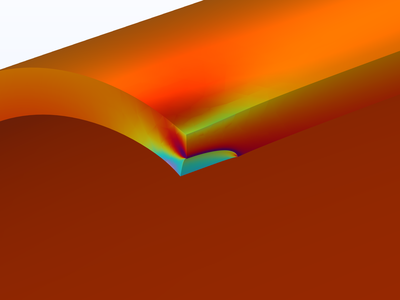
In this benchmark example, a semi-elliptical crack at the inner surface of a cylinder is studied. The inside of the cylinder and the crack faces are subjected to a pressure load. The J-integral is calculated along the crack front, and the stress intensity factor is then compared with the ... Read More

This model shows how to add several linked mobility models to the simple MOSFET example. Read More
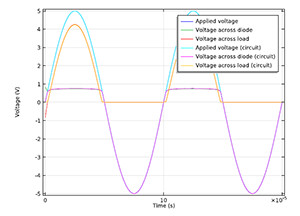
This model extracts spice parameters for a silicon p-n junction diode. The spice parameters are used to create a lumped-element equivalent circuit model of a half-wave rectifier that is compared to a full device level simulation. In this example, a device model is made by connecting a 2D ... Read More
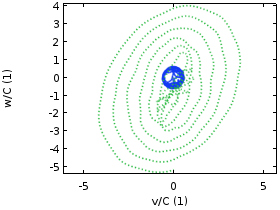
Bearing clearances should be kept minimum to avoid non-synchronous vibration of a rotor. However, a tight clearance reduces the durability of the bearing. This example illustrates modeling of the vibration induced by nonlinear contact for different radial clearances. It is shown that ... Read More
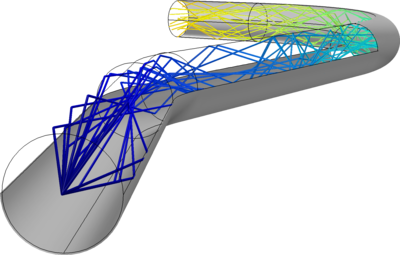
Light pipes are structures that can be used to transport light between different locations. In general, they can be divided into two major groups: tubes lined with a reflective coating and transparent solids that contain light via total internal reflection. In this tutorial, light is ... Read More
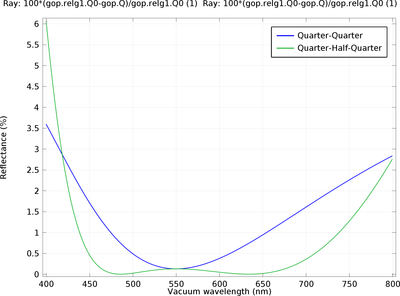
Anti-reflective coatings are frequently used in optical systems to reduce the amount of stray light produced when a beam of light crosses from one medium into another medium with a different refractive index. The simplest example of an anti-reflective coating is a quarter-wavelength ... Read More
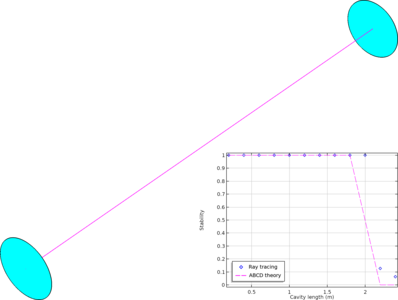
In this model, two concave mirrors are placed at a distance and a ray is released from a point inside the cavity. Then the ray is traced for a predefined time period that is sufficiently long. Ray tracing continues until the predefined computation time has passed if the laser cavity is ... Read More
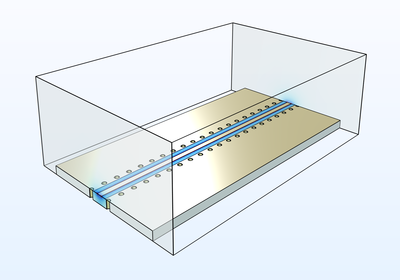
This tutorial example shows how to set port features in a physics interface when designing a grounded coplanar waveguide (GCPW) circuit that is useful for mmWave applications. Read More
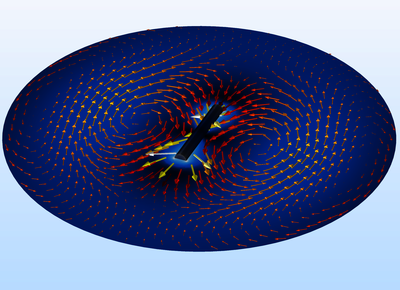
A metallic cylindrical rod is hidden inside a spherical dielectric shell and its orientation is unknown. By studying the polarization-dependent scattered field of a cylindrical object and performing a parametric sweep as a function of polarization angle, the rod is detected for the ... Read More


