
The Application Gallery features COMSOL Multiphysics® tutorial and demo app files pertinent to the electrical, structural, acoustics, fluid, heat, and chemical disciplines. You can use these examples as a starting point for your own simulation work by downloading the tutorial model or demo app file and its accompanying instructions.
Search for tutorials and apps relevant to your area of expertise via the Quick Search feature. Note that many of the examples featured here can also be accessed via the Application Libraries that are built into the COMSOL Multiphysics® software and available from the File menu.
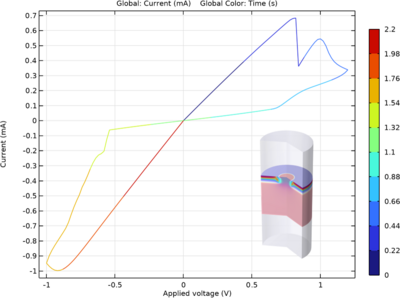
This model captures the dynamic resistive switching behavior of an oxide-based memristor. The device features a thin metal oxide layer sandwiched between two metal electrodes. When a voltage is applied, oxygen vacancies within the oxide layer migrate, acting as charge carriers and ... Read More
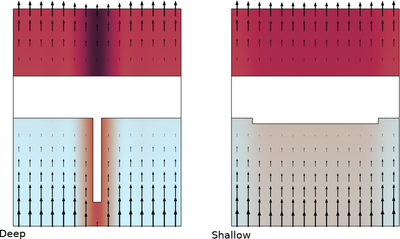
The copper current collector on negative graphite electrodes in lithium-ion batteries have been seen to dissolve at over discharge. This can be a safety concern as the dissolution damages the current collector irreversibly and dissolved copper ions can redeposit and form dendrites. ... Read More
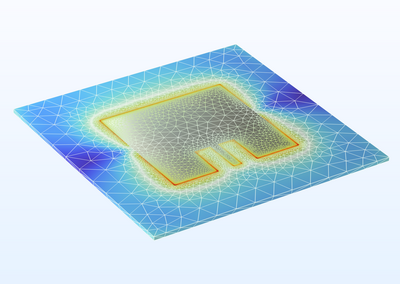
The model utilizes a dedicated mesh refinement study, Frequency Domain RF Adaptive Mesh, which dynamically refines the mesh in the region of interest. For the Application Library model Microstrip Patch Antenna, it increases the mesh resolution around areas with high field variations. The ... Read More
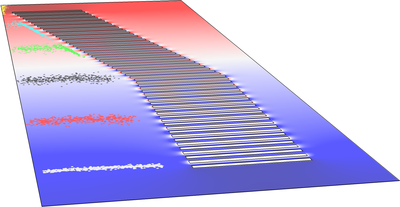
An electrodynamic ion funnel provides an efficient means of transferring ions from regions of high pressure to high vacuum. The ion funnel can couple devices which generally operate at pressures of different orders of magnitude, such as ion mobility spectrometers and mass spectrometers, ... Read More

Manual design optimization typically requires numerous sweeps over a parameterized geometry, but it does not guarantee optimal performance under given conditions. Shape optimization removes the need for explicit parameterization and can achieve comparable or even better performance in a ... Read More
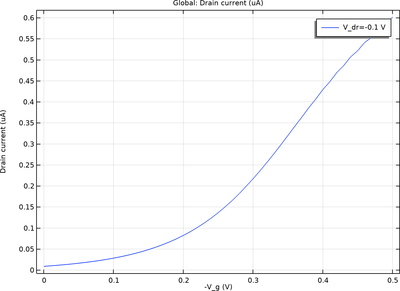
This model shows how to model an electrolyte-gated organic field-effect transistor based on a general drift–diffusion model. The model uses the Transport of Charge Carriers interface and the Electrostatics interface. The transistor characteristics are visualized. Formation of the EDLs in ... Read More

This tutorial model solves for a hydrogen plasma created in a microwave cavity. The model computes the fluid flow and gas heating self-consistently. Read More

A plane electromagnetic wave is incident on a metallic sphere partially embedded on a substrate. In this electromagnetic scattering problem, the far-field variables are computed for a few elevation angles of incidence. Read More
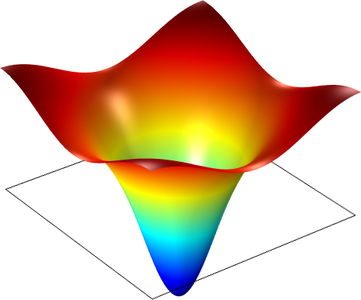
This model investigates the wave propagation in a photonic crystal that consists of GaAs pillars placed equidistant from each other. The distance between the pillars determines a relationship between the wave number and the frequency of the light, which prevents light of certain ... Read More
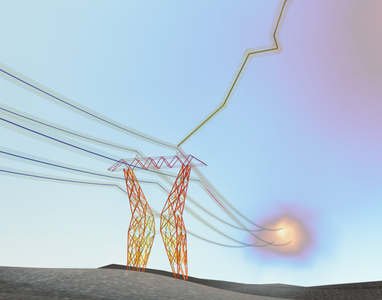
This model demonstrates the analysis of lightning surges on high voltage transmission line towers. Lightning carrying a current of 10 kA struck one of the tower's shielded wires. The induced voltage at the three-phase conductors are computed. Some highlights of this model: Perform ... Read More


