
The Application Gallery features COMSOL Multiphysics® tutorial and demo app files pertinent to the electrical, structural, acoustics, fluid, heat, and chemical disciplines. You can use these examples as a starting point for your own simulation work by downloading the tutorial model or demo app file and its accompanying instructions.
Search for tutorials and apps relevant to your area of expertise via the Quick Search feature. Note that many of the examples featured here can also be accessed via the Application Libraries that are built into the COMSOL Multiphysics® software and available from the File menu.
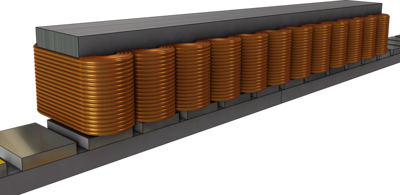
Linear motors are used in many applications in need of translational motion. Typical characteristics of linear motor designs are high precision or quick acceleration. This model investigates a synchronous motor with three-phase winding on the stationary part and permanent magnets on the ... Read More
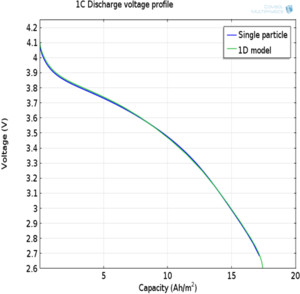
An isothermal single particle model formulation for a lithium-ion battery is presented in this work. The single particle model is a simplification of the 1D formulation for a lithium-ion battery along with a few assumptions. The model is typically valid for low-medium current scenarios. ... Read More
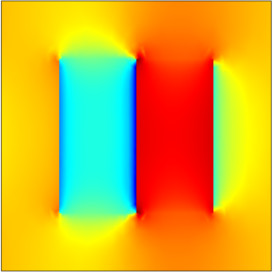
Magnetotellurics is a method for estimating the resistivity profile of the Earth's subsurface using the natural electromagnetic source provided by the ionosphere. This model was defined by Zhdanov et al. in a study published in 1997. In this article, various scientific groups compared ... Read More
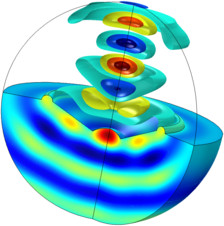
Example of a moving-coil loudspeaker where lumped parameters represent the behavior of the electrical and mechanical components. The Thiele-Small parameters (small-signal parameters) serve as input to the lumped model, which is represented using the Electric Circuit interface. The ... Read More
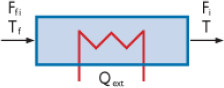
This example considers the thermal cracking of acetone, which is a key step in the production of acetic anhydride. The gas phase reaction takes place under nonisothermal conditions in a plug-flow reactor. As the cracking chemistry is endothermic, control over the temperature in the ... Read More
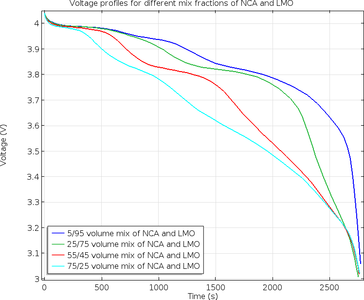
Lithium-ion batteries can have multiple active materials in both the positive and negative electrodes. For example, the positive electrode can have a mix of active materials. These materials can have different design properties (volume fraction, particle size), thermodynamic properties ... Read More

In this tutorial, a PM motor with 10 rotor poles and 12 stator slots is modeled in 2D, to capture the torque ripple over an electrical period and map the volumetric loss density in the rotor and stator iron. Read More
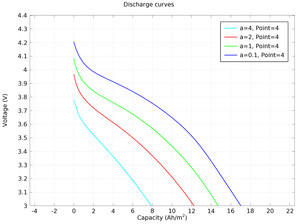
This model demonstrates the Lithium-Ion Battery interface for studying the discharge and charge of a lithium-ion battery for a given set of material properties. The geometry is in one dimension and the model is isothermal. Battery developers can use the model to investigate the influence ... Read More
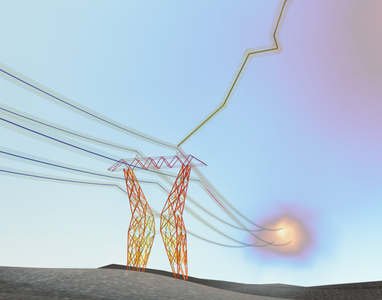
This model demonstrates the analysis of lightning surges on high voltage transmission line towers. Lightning carrying a current of 10 kA struck one of the tower's shielded wires. The induced voltage at the three-phase conductors are computed. Some highlights of this model: Perform ... Read More
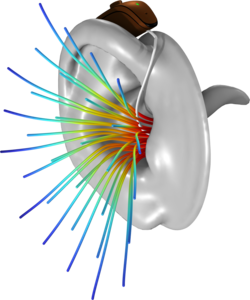
This model demonstrates how to perform a hearing aid acoustic feedback response analysis, including both the in-ear hearing aid and the hearing aid cassette. The hearing aid modeled is a ReSound OMNIA™ device from GN Hearing A/S. The hearing aid is tested on a combined pinna and ear ... Read More


