
The Application Gallery features COMSOL Multiphysics® tutorial and demo app files pertinent to the electrical, structural, acoustics, fluid, heat, and chemical disciplines. You can use these examples as a starting point for your own simulation work by downloading the tutorial model or demo app file and its accompanying instructions.
Search for tutorials and apps relevant to your area of expertise via the Quick Search feature. Note that many of the examples featured here can also be accessed via the Application Libraries that are built into the COMSOL Multiphysics® software and available from the File menu.
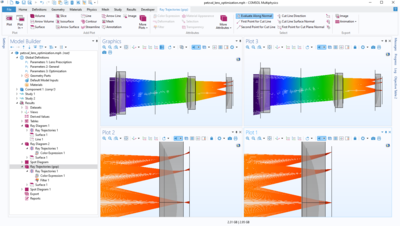
This example shows how to perform parameter optimization on a lens system. The optimization is motivated by the replacement of one of the glasses in a prior optical prescription with a new glass having slightly different optical dispersion coefficients. The control parameters are the ... Read More
The Gregory-Maksutov telescope is a simple catadioptric telescope comprising a spherical corrector lens and a spherical primary mirror. In this example the corrector lens and mirror are formed using the 'Spherical Lens 3D' and 'Spherical Mirror 3D' parts respectively from the Ray Optics ... Read More

Compact camera modules are widely used in electronic devices such as mobile phones and tablet computers. In order to reduce both the size and number of elements required the optical design will typically incorporate several highly aspheric surfaces. This model demonstrates a five element ... Read More
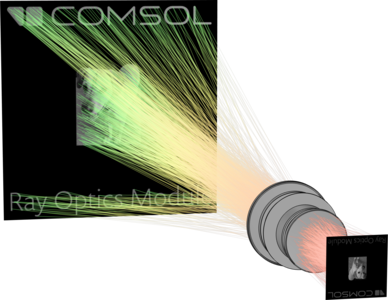
This example demonstrates how to import a bitmap which can be used to simulate an image using ray tracing. The example is based on the Double Gauss Lens tutorial from the Ray Optics Module Application Library. The first study has been modified so that the Spot Diagram "auto-focus" tool ... Read More
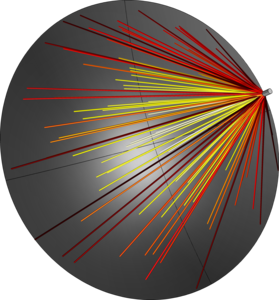
A paraboloidal dish can concentrate solar energy onto a target (receiver), resulting in very high local heat fluxes. This can be used to generate steam, which can be used to power a generator, or hydrogen, which can be used directly as a fuel source. In this model, the heat flux arriving ... Read More
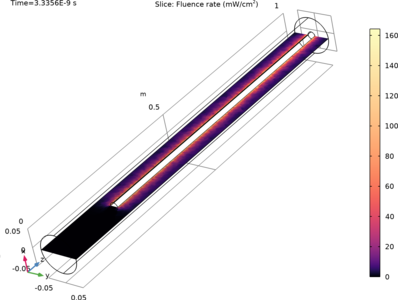
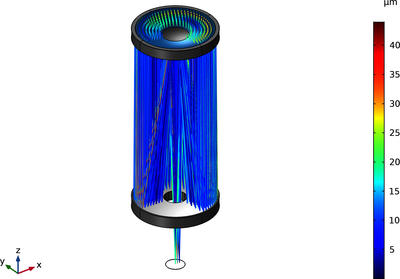
This model demonstrates how to compute the volumetric fluence rate in an ultraviolet (UV) reactor. The geometry is the annular fluid region surrounding a cylindrical lamp. The effect of reflection at the reactor walls on the radial fluence rate distribution is considered. Read More
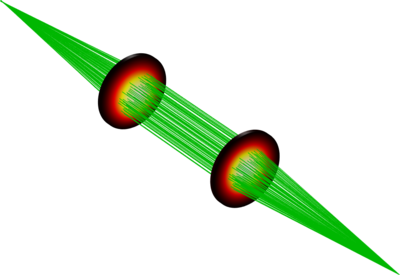
A modern high-power industrial fiber laser system can deliver up to 3kW of single-mode laser radiation on to surfaces to be cut, drilled, welded or marked. Even using highly transmissive materials, the optical component used to focus the laser beam onto target surfaces can be affected ... Read More
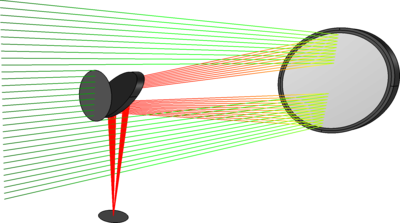
Newtonian telescopes, first invented in 1668 by Isaac Netwon, are still used today because of their low cost and simple design. Rays of light propagate from sources located at infinity, into the telescope. The rays reflect off a parabolic mirror, onto a flat mirror, and into the focal ... Read More
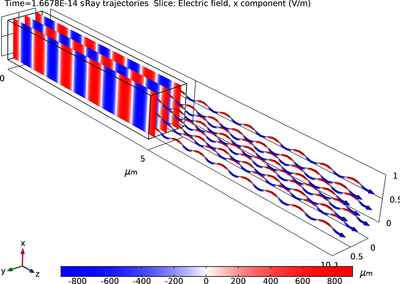
This tutorial shows how to set up a ray release based on the incident electric field at a boundary. First the Electomagnetic Waves, Frequency Domain interface is used to solve for the electric field of a plane wave. Then rays are released with initial intensity and polarization matching ... Read More
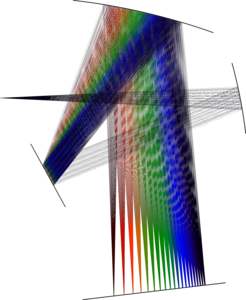
A Czerny-Turner monochromator spatially separates polychromatic light into a series of monochromatic rays. This model simulates a crossed Czerny-Turner configuration that consists of a spherical collimating mirror, a planar diffraction grating, a spherical imaging mirror, and an array ... Read More


