
The Application Gallery features COMSOL Multiphysics® tutorial and demo app files pertinent to the electrical, structural, acoustics, fluid, heat, and chemical disciplines. You can use these examples as a starting point for your own simulation work by downloading the tutorial model or demo app file and its accompanying instructions.
Search for tutorials and apps relevant to your area of expertise via the Quick Search feature. Note that many of the examples featured here can also be accessed via the Application Libraries that are built into the COMSOL Multiphysics® software and available from the File menu.
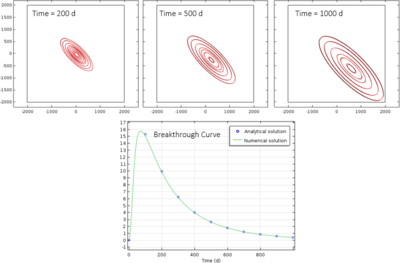
Predicting the transport of solutes that move with subsurface fluids is of general interest in environmental engineering and geosciences. Solutes may not only be pollutants but also artifical tracers added to the groundwater for investigation purposes. This model tracks a solute over ... Read More
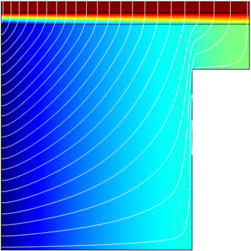
Fluids that move through pore spaces in an aquifer or reservoir can shield the porous medium from stress because they bear part of the load from, for instance, overlying rocks, sediments, fluids, and buildings. Withdrawing fluids from the pore space increases the stress the solids bear, ... Read More
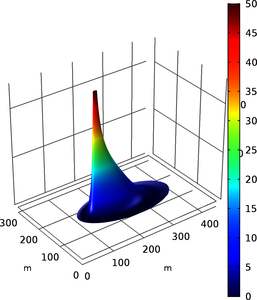
This model tracks a contaminant that enters an aquifer at a point, such as an injection well or toxic spill, and spreads through the aquifer with time. The model has an analytic solution developed by Wilson and Miller. This analytic solution has been used to test several dedicated fluid ... Read More
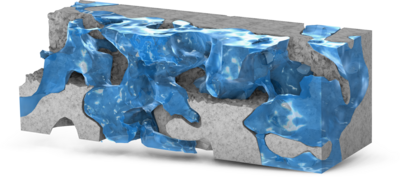
Digital Rock technology utilizes high-resolution imaging techniques, such as SEM and X-ray CT, to characterize the pore structures of rock cores. This approach enables pore-scale modeling of reservoir rocks, offering valuable insights into pore morphology, connectivity, and fluid ... Read More
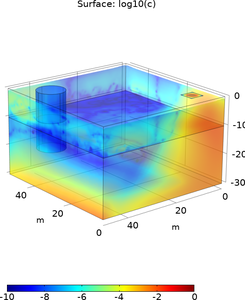
A simple model for groundwater contamination portrays a well that is bored into an aquifer. The aquifer consists of a partially saturated layer and a fully saturated layer. The model investigates how much of the contaminant ends up in the well after a contaminant is introduced in the ... Read More
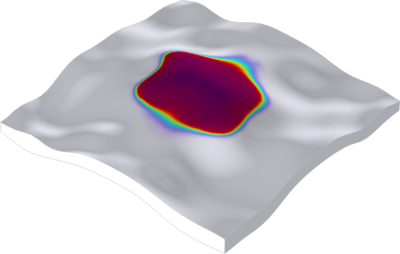
Modeling and simulation is useful for evaluating the feasibility of storing hydrogen underground. In this example of a geological formation, hydrogen is injected through an injection well at a rate of 1 kg/s over a period of 2 years, until it is ready to be extracted and discharged ... Read More
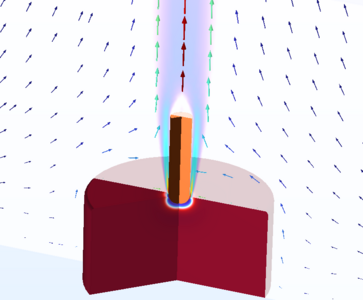
In electrosurgery, high-power AC current from a probe is driven into tissue in order to cut and coagulate it. The current causes rapid Joule heating near the tip, and as temperatures reach 100°C, water and blood vaporize and the tissue desiccates, enabling cutting or sealing. This ... Read More


