
The Application Gallery features COMSOL Multiphysics® tutorial and demo app files pertinent to the electrical, structural, acoustics, fluid, heat, and chemical disciplines. You can use these examples as a starting point for your own simulation work by downloading the tutorial model or demo app file and its accompanying instructions.
Search for tutorials and apps relevant to your area of expertise via the Quick Search feature. Note that many of the examples featured here can also be accessed via the Application Libraries that are built into the COMSOL Multiphysics® software and available from the File menu.

In this model, the acoustics of the Small Hall in the Konzerthaus Berlin is simulated with Pressure Acoustics, Time Explicit. This method can take advantage of running on GPUs. A study of the room is performed in the low frequency range. The room acoustic parameters are derived from the ... Read More
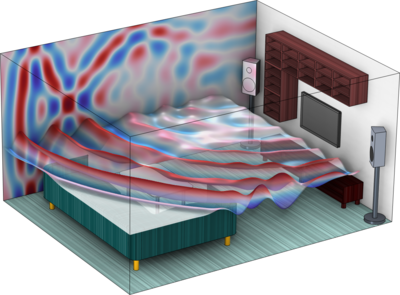
The use of wave-based techniques for room acoustic simulations has spread in the last years due to the increase in computational performance as well as the development of new numerical methods. The challenge of including realistic impedance conditions at walls is traditionally solved in ... Read More
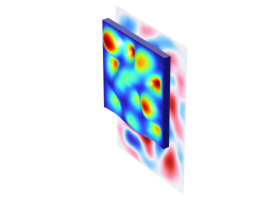
This model presents a practical and efficient method to compute the sound transmission loss (STL) through a building component, specifically this example treats the case of a concrete wall. The method used here is valid as long as the component has little influence on the acoustic field ... Read More
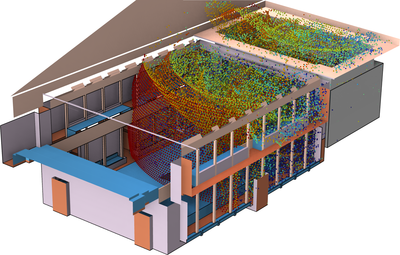
In this model, the acoustics of the Small Hall in the Konzerthaus Berlin is simulated with ray tracing. A full study of the room is performed in 1/3-octave bands with 10 pairs of source-receiver positions. The room acoustic parameters are derived from the calculated impulse responses, ... Read More
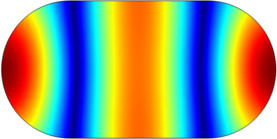
In this model, compute the propagating modes in the chamber of an automotive muffler. The geometry is a cross-section of the chamber in the Absorptive Muffler example. The model’s purpose is to study the shape of the propagating modes and to find their cut-off frequencies. As discussed ... Read More
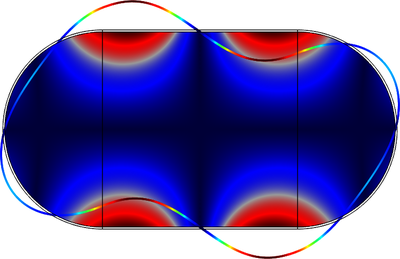
This example consists of a 2D analysis of propagation modes in the chamber of a muffler. In this case, the muffler walls are considered to be made of a linear elastic material and account for their influence on the modes propagating through the cross section of the chamber. This analysis ... Read More
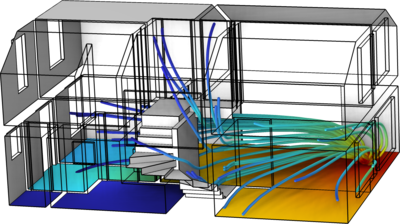
This model shows an application of the Acoustic Diffusion Equation physics interface. The acoustics in a two-story one-family house consisting of 10 rooms is analyzed. The steady state sound pressure level and energy density distributions are analyzed for a monopole source located in ... Read More
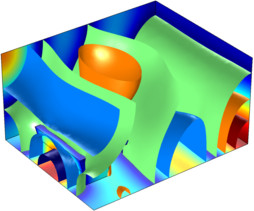
When designing a concert hall, it is extremely important to take the resonances into account. For a clear and neutral sound, the eigenfrequencies should be evenly spread through the registers. For the home stereo owner, who cannot actually change the shape of his living room, another ... Read More
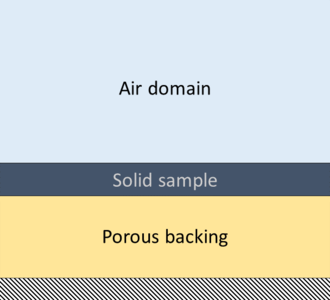
This app allows to calculate the absorption coefficient and surface impedance of a sound absorbers for normal and random incidences. The computed quantities can be used when setting up boundary conditions in a Pressure Acoustics, Frequency Domain model or a Ray Acoustics model. The ... Read More
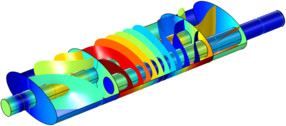
This model simulates the pressure wave propagation in a muffler for a combustion engine. It uses a general approach for analysis of damping of the propagation of harmonic pressure waves. The model is solved in the frequency domain and provides efficient damping in a frequency range of ... Read More


