
Explore the innovative ways multiphysics simulation is being used worldwide to advance research
Multiphysics modeling and simulation drives innovation across industries and academia — as is evidenced by the many uses showcased in the technical papers and posters presented by engineers, researchers, and scientists at the COMSOL Conference each year.
Draw inspiration from the recent proceedings collected below, or, to find a specific presentation or filter by application area or conference year/location, use the Quick Search tool.
View the COMSOL Conference 2026 Collection

An interaction of aluminum aircraft skins with a laboratory-simulated, low-level, long-duration, continuing current representative of a natural lightning flash was modeled with COMSOL Multiphysics. For the analysis of the lightning direct effects on aircraft, the external environment is ... Read More

A fully filled sphere of ferrofluid has constant demagnetizing factors in all three Cartesian directions such that when subjected to a uniform external rotating magnetic field the internal field is also uniform, and ultrasound measurements give no observable flow. Non-uniform magnetic ... Read More

Charged particle accelerators require large dipole fields with stringent homogeneity requirements needed to bend particle beams without defocussing. Commonly superconducting saddle coil magnets are used with an iron core to enhance the bore field. The iron uneven magnetization brings ... Read More
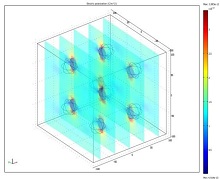
In this work, we present the effective properties of nanodielectrics with gold (Au) nanoparticles embedded in polymer (Polyvinyl Pyrrolidone (PVP)) matrix, calculated by using finite element method (FEM) based simulation in COMSOL Multiphysics software. Drude model is used to calculate ... Read More
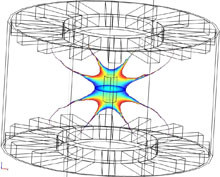
For low-field NMR (Nuclear magnetic resonance), NdFeB permanent magnet arrangements are proposed to provide the static polarizing magnetic field. Especially a parallel and a circular arrangement of the permanent magnets, iron yokes and small shim magnets were tested and improved by ... Read More
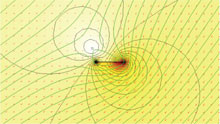
This work presents a method to calculate AC losses in thin conductors such as the commercially available second generation superconducting wires through a multiscale meshing technique. The main idea is to use large aspect ratio elements to accurately simulate thin material layers. For a ... Read More

Two simulations of the performance of a Paper Insulated Lead Covered (PILC) Medium Voltage (MV) underground cable are presented. The first presents the thermal response of a cable, over seven days, to a realistic load with a diurnal variation. The second concentrates on the variation of ... Read More

In this paper 3D electro-thermal FE Model using COMSOL Multiphysics® software of power vertical MOSFET used in the automotive industry is presented. This model is used to analyze the effects of bonding wire lift off defect and to study the influence of metallization thickness and ... Read More


