
Explore the innovative ways multiphysics simulation is being used worldwide to advance research
Multiphysics modeling and simulation drives innovation across industries and academia — as is evidenced by the many uses showcased in the technical papers and posters presented by engineers, researchers, and scientists at the COMSOL Conference each year.
Draw inspiration from the recent proceedings collected below, or, to find a specific presentation or filter by application area or conference year/location, use the Quick Search tool.
View the COMSOL Conference 2026 Collection

Modeling of fractured porous media systems is currently of high interest in various academic and applied fields, mainly in the geological and material sciences. The very different scales of the region of an application case on the larger end and the fracture on the lower end pose a ... Read More

The unconventional shale gas reservoirs have a major contribution to hydrocarbon production in recent years. The hydraulic stimulation technique is being used to enhance the productivity of the target reservoirs. The drilled wellbore and existing natural fractures in the host rocks have ... Read More

Subduction, the process through which the cold and dense oceanic lithosphere sinks into the highly viscous mantle, is the main driving force of plate tectonics and is important for recycling the Earth's materials. Active subduction has not been observed in any other planet in our solar ... Read More

COMSOL Multiphysics® is used in various engineering fields and has recently been introduced as an efficient tool to solve certain geophysical problems. We used this software to study the mechanisms associated with the buckling formation at a plate-tectonic scale on Earth. Buckling is not ... Read More

In plate tectonics, the relative motion between plates at a plate boundary generates tectonic stress, and most earthquakes occur at these plate boundaries. However, only a small proportion of earthquakes occur in plate interiors, such as the 1811–12 New Madrid Earthquake (8.1 Mw) in the ... Read More
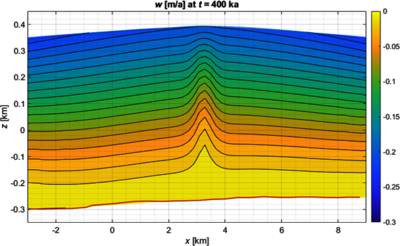
Ice flows because at low stresses it deforms viscously; the viscosity depends upon the stress. The lubrication approximation (LA) states shear stress is proportional to the product of the ice depth and surface slope. At ice divides the slope and shear stress are zero meaning the ... Read More

Geological Carbon Storage (GCS) is viewed as a viable option to reduce Carbon Dioxide (CO2) emissions. In particular, CO2 injection into deep saline formations (DSF) has been the subject of numerous investigations during the last decade, including pilot and demonstration projects [Reiner ... Read More

For hydrogeologists pumping tests are the most common method to obtain characteristic aquifer properties, like transmissivity and storativity. For the evaluation of pumping tests it is common practice to compare field measurements and 1D analytical solutions. Numerical methods offer the ... Read More


