
See How Modeling and Simulation Is Used Across Industries
Multiphysics modeling and simulation drives innovation across industries and academia — as is evidenced by the many uses showcased in the technical papers and posters presented by engineers, researchers, and scientists at the COMSOL Conference each year.
Draw inspiration from the recent proceedings collected below, or, to find a specific presentation or filter by application area or conference year/location, use the Quick Search tool.
View the COMSOL Conference 2025 Collection

This project utilizes the heat transfer module of the COMSOL Multiphysics environment to model the effects that an ohmic heating probe will have on neural tissue. The model quantifies the thermal impact of active components embedded on a neural micro probe by solving the Penne’s bioheat ... Read More
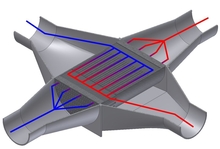
For the numeric investigations of the high temperature compact heat exchanger two numeric models with and without the regards of the velocity field development were used. The results of the comparison of the numeric and experimental data confirm the necessity of regarding the velocity ... Read More

In this work, a 2D dynamic simulation for a portion of metal hydride based hydrogen storage tank was performed using computational software COMSOL 4.0a Multiphysics. The software is used to simulate the diffusion and heating of hydrogen in both radial and axial directions. The model ... Read More
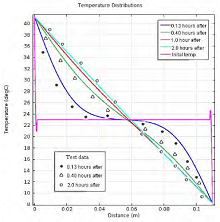
This paper is a part of a study on energy piles for heating and cooling of buildings. Energy piles are used for two reasons: (1) to transfer structural loads to foundation soils, and (2) to transfer heat from foundation soils to the building for space heating in winter time and for ... Read More

Liquid transport in lab-on-a-chip (LOC) devices occurs through a microchannel that uses an electroosmotic flow actuation mechanism. This method has a plug-like velocity profile, which is ideal in species transport and in wall-bounded reactions. Under substantial joule heating, it is not ... Read More

In this paper, the influence of carbon nanotube (CNT) in a metal matrix on the buckling behavior of the resulting nanocomposite plate is studied. The Young's moduli of CNT reinforced nanocomposite are predicted first using the representative volume element (RVE) method. CNTs are ... Read More
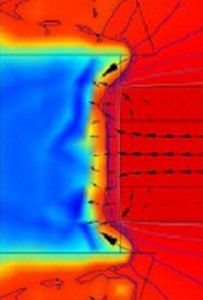
The hydro-mechanical (HM) numerical simulation of a shaft seal installed at a fracture zone in a hypothetical host rock using COMSOL is presented. Two different stages are considered in the numerical modelling. Stage 1 simulates the groundwater flow into an open shaft. Stage 2 simulates ... Read More
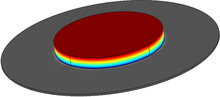
Solid oxide fuel cells (SOFCs) are electrochemical conversion devices that utilize ceramics as their electrolyte material for oxygen conduction. Compared to other types of fuel cells, they operate at relatively high temperatures, typically 400°C to 1000°C, and have an electrical ... Read More

Natural groundwater flow can increase the efficiency of geothermal system. But groundwater flow is not available everywhere. A patented new idea is to use air injection well to create artificial flow in sandy or gritty soils. The governing equations of fluid flow and heat transfer ... Read More
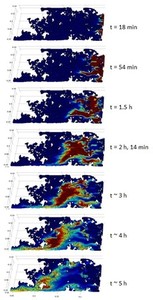
We apply COMSOL Multiphysics for reproducing our experimental observations of fluid flow and transport processes in geological media. Our experimental GeoEPT-method allows the 4D monitoring of transport processes in geological material on laboratory scale. Explicitly we import ... Read More


