
See How Modeling and Simulation Is Used Across Industries
Multiphysics modeling and simulation drives innovation across industries and academia — as is evidenced by the many uses showcased in the technical papers and posters presented by engineers, researchers, and scientists at the COMSOL Conference each year.
Draw inspiration from the recent proceedings collected below, or, to find a specific presentation or filter by application area or conference year/location, use the Quick Search tool.
View the COMSOL Conference 2025 Collection

Electrochemical machining (ECM) uses electrolysis to precisely remove material at high rates. ECM has many advantages over conventional machining: no tool wear, no induced mechanical or thermal stresses, high removal rates virtually independent of material hardness or strength, and ... Read More

In this paper a new method for turbulent combustion modeling is introduced in COMSOL Multiphysics®. The method is called Flamelet Generated Manifolds (FGM). The method is based on the concept of flamelets, elemental reaction layers in combustion. The only hypothesis is that the turbulent ... Read More
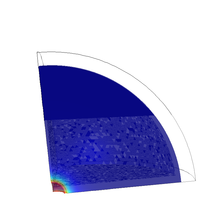
We examine the poroelastics mode, which couples hydraulics and mechanics by some basic benchmarks. For cases with analytical solutions we check the accuracy for changing meshes and calculate the convergence rate. Read More

Efficient and low cost deionization is a major technology challenge. Energy efficient technologies like Capacitive deionization (CDI) are possible emerging alternatives. In the present work, we simulate charge adsorption in a 2D flow cell to study its dependence on applied potential and ... Read More

A benchmark study was carried out by the Swiss Nuclear Safety Inspectorate (ENSI) in collaboration with the Laboratory for Waste Management (LES) of the Paul Scherrer Institute (PSI) in order to evaluate the capabilities of the program COMSOL for the calculation of the transport of ... Read More

The purpose of this study is to understand the growth mechanism of copper (Cu) films on a Cu-Zn system substrate with a pre-defined pattern. The pattern was defined by conducting a selective etching process on a two-phase polycrystalline substrate. As a result of this process, there were ... Read More
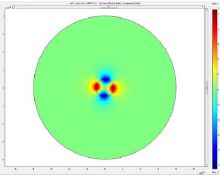
Distributed Feedback Fiber Laser (DFB-FL) sensors are increasingly used in aeronautical applications. One of the newest such applications consists in detecting the “transition” zone between laminar and turbulent air flow upon the extrados surface of an aircraft wing. In this specific ... Read More

The Direct Methanol Fuel Cell (DMFC) working is dependent on the concentration of methanol in water before it is introduced in the anode. DMFC has a high energy density when generating electrical power from fuel, and is an attractive power source for portable devices. A fundamental ... Read More
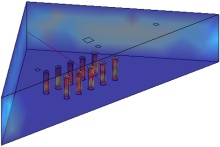
The aim of this Project is to obtain a temporary and spatial evolution model of the temperature into a meeting room with the aim to develop an efficient energy mechanism which can improve the air conditioner control system. The project has considered two extremes cases: on the one hand a ... Read More

Dr. R. N Singh is currently a INSA Senior Scientist. Prior to this appointment, he was a CSIR Emeritus Scientist at the National Geophysical Research Institute (NGRI), Hyderabad. He has been the Scientist-in-Charge of CSIR Centre of Mathematical Modeling and Computer Simulation, ... Read More


