
Explore the innovative ways multiphysics simulation is being used worldwide to advance research
Multiphysics modeling and simulation drives innovation across industries and academia — as is evidenced by the many uses showcased in the technical papers and posters presented by engineers, researchers, and scientists at the COMSOL Conference each year.
Draw inspiration from the recent proceedings collected below, or, to find a specific presentation or filter by application area or conference year/location, use the Quick Search tool.
View the COMSOL Conference 2025 Collection

High power consumption chips have already become a major challenge for modern processors causing low thermal performances. Existing thermal solutions are not able to solve these high temperature issues efficiently. Two-phase cooling devices such as heat pipes and vapor chambers have ... Read More

Renewable energy sources such as solar and wind are intermittent in nature. Their effective utilization requires efficient, low cost energy storage systems to complement energy harnessing systems. The rechargeable flow batteries have emerged as the most suitable candidates due to their ... Read More
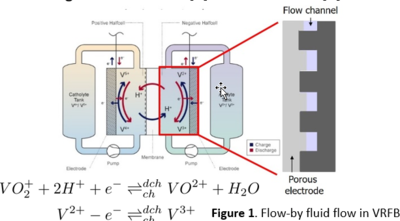
The all vanadium redox flow battery (VRFB) is a promising electrochemical energy storage technology with the potential to play an important role in future power grids [1]. While the common VRFB cell design is planar, a tubular cell design might display advantages as reduced sealing ... Read More

Current and emerging energy storage devices need to be enhanced to cope with the energy and power density requirements of different applications. Electrochemical models are helpful tools for the development and redesign of existing Li-ion batteries as well as to support more innovative ... Read More

This report explores the utilization of COMSOL® to investigate material properties and perform finite element analysis in solid-state batteries. Over the years, the increase of energy density in Lithium-Ion batteries has begun to plateau. The impact of mainstream consumer electronics ... Read More

Modeling of 3D AC electro-osmotic pumps is relevant to the creation of portable or implantable lab-on-a-chip devices for mm/s tunable fluid flows attainable with battery scale voltages. In this analysis using COMSOL Multiphysics we investigate the modeling challenges of computationally ... Read More

Due to the rapid growth of the electromobility market much effort currently is being put into investigating electric vehicle batteries. Optimizing the microstructure of the cell components is playing an important role in extending range, enhancing fast charging capabilities and reducing ... Read More

Large format Li-Ion battery cells (LIBC), often employed in electric vehicles (EV), show notable gradients in current and temperature distribution. This inhomogeneity can influence the cell’s safety and accelerate battery aging. It is, however, difficult to determine the local ... Read More

A lithium-ion battery comprises of two intercalating electrodes separated by a membrane, sandwiched between aluminum and copper current collecting plates. The battery performance depends upon several parameters and its operating conditions. In this work we developed a model for a lithium ... Read More

为提高锂离子电池的能量密度,人们做出了许多努力,其中设计厚电极是一种很有前途的方法。传统上,在构建厚电极时会考虑动力学效应,例如降低迂回度以促进离子传输。这项工作创新性地研究了动力学和热力学对电极过程的耦合效应,并通过可视化电极过程对两者进行了竞争分析。结果表明,倾斜的平衡电位曲线有利于电极的均匀利用,但严重的动力学约束会使热力学调节失效。因此,改变电极的热力学特性以加强调节效果是一种很有前途的方法,而动力学约束则是限制电池容量释放的内在因素。深入的分析表明,确保离子和电子的混合控制可以显著缓解动力学反应的异质性。作为概念验证,我们构建了具有垂直通道的厚电极 ... Read More


