
See How Modeling and Simulation Is Used Across Industries
Multiphysics modeling and simulation drives innovation across industries and academia — as is evidenced by the many uses showcased in the technical papers and posters presented by engineers, researchers, and scientists at the COMSOL Conference each year.
Draw inspiration from the recent proceedings collected below, or, to find a specific presentation or filter by application area or conference year/location, use the Quick Search tool.
View the COMSOL Conference 2025 Collection

There are only two types of naturally-occurring earthquakes anywhere on the Earth: 1) those associated with the dynamics of plate tectonics and 2) those associated with the dynamics of the hydrologic cycle. The first type is characteristic of an INTERplate setting (like the San Andreas ... Read More
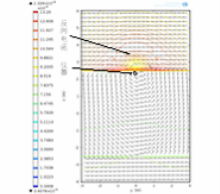
斜井和水平井中阵列感应响应特性研究是测井数据正确解释的基础。在斜井和水平井中,井轨迹可能以任意角度进出水平地层,阵列感应测井响应计算是复杂的三维电磁场数值计算。基于 COMSOL Multiphysics® 软件的 AD/DC 模块开发完成斜井和水平井中的阵列感应响应三维数值计算方法。详细计算分析水平井和斜井中井位置、目的层厚、目的层电导率、围岩电导率以及目的层与围岩电导率对比度对阵列感应测井响应的影响。结果表明,水平井的阵列感应测井响应特性取决于层厚、电导率对比度、子阵列间距、仪器距层界面距离等多种因素。当层厚大于仪器分层厚度时,水平井响应与直井响应接近 ... Read More
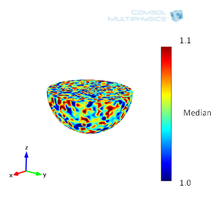
Soil’s electromagnetic properties adversely affect the performance of electromagnetic induction (EMI) sensors and if conditions are severe enough, render them useless. A simple circuit model is often used to express the electromagnetic induction response of a target analytically. This ... Read More

Poroelasticity equations describe the interaction between fluid flow and solids deformation within a porous medium. Modeling of poroelasticity is coupling between elastic deformation of porous materials and Darcy’s law. Poroelasticity has numerous real world applications such as in ... Read More

The Solargeotherm project is assessing the possibility of using vertical geothermal probes drilled into a rock mass (bedrock) for storing the thermal energy produced by solar panels and later releasing it. The research project relies on the installation of an experimental system and the ... Read More
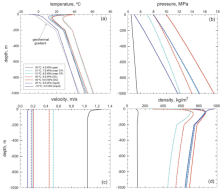
Injection conditions of CO2 at the wellhead may play a major role on the flow behavior through the wellbore. The density and the injection rate reached at the bottomhole are key factors affecting the performance and efficiency of CO2 geological storage. In this work, a model of non ... Read More

Introduction: This study presents the 3D electromagnetic model in layered media using induction logging tool. This algorithm utilizes electromagnetic wave frequency domain (EWFD) interface of Maxwell equations. Electromagnetic methods are popular tools for the measurement of resistivity ... Read More
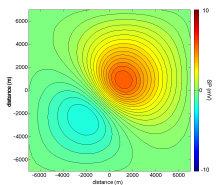
Geothermal systems represent a large resource that can provide, with a reasonable investment, a very high and cost-effective power generating capacity. Despite its unquestionable potential, geothermal exploitation has long been perceived as limited, mainly because of the dependence from ... Read More

Gas generation and transport through porous media is a process common to many field applications such as radioactive waste and underground gas storage. In these operations, the gas phase evolution depends on the thermodynamic conditions at depth, the properties of the fluids (density, ... Read More
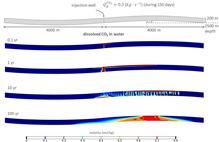
The capture and storage of CO2 in deep geological formations is one of the proposed solutions to reduce CO2 emissions to the atmosphere. CO2 is injected as a supercritical fluid deep below a confining geological formation that prevents its return to the atmosphere. In general, four ... Read More


