
See How Modeling and Simulation Is Used Across Industries
Multiphysics modeling and simulation drives innovation across industries and academia — as is evidenced by the many uses showcased in the technical papers and posters presented by engineers, researchers, and scientists at the COMSOL Conference each year.
Draw inspiration from the recent proceedings collected below, or, to find a specific presentation or filter by application area or conference year/location, use the Quick Search tool.
View the COMSOL Conference 2025 Collection
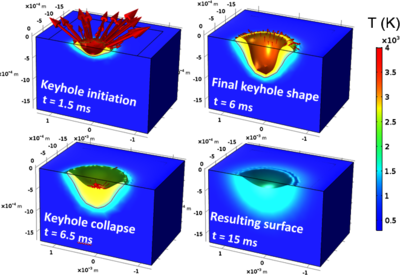
The interaction of high power laser beam with metallic materials produces a number of interconnected phenomena that represent a serious challenge for numerical modeling, especially for creation of auto-consistent models. Additional difficulty consists in lack of data on materials ... Read More
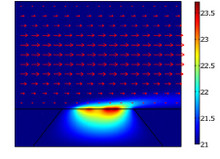
In this work, we present simulations of a novel micromachined calorimetric flow sensor using COMSOL Multiphysics. The sensor is based on four germanium thermistors that serve as heat sources and as temperature sensors simultaneously. In operational mode, the heated membrane is cooled by ... Read More

Single droplet drying (SDD) is an established experimental set up in which an isolated droplet is dried under a controlled environment. The drying behavior in the SDD experiments is often complicated and challenged to observe. Hence, a robust model of single droplet drying can provide an ... Read More

In this work we report a numerical model of a Rotating Disk Electrode (RDE) voltammetry in a finite size domain. Thus, explaining the discrepancy of the diffusion coefficient obtained from the experimental rotating speed, with respect to the literature data. We achieved a very good ... Read More
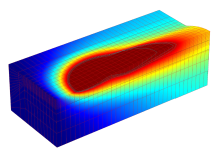
Additive manufacturing is attracting more and more interest. Laser Cladding is one of these additive manufacturing processes. For this a quasi-stationary physical based 3D process model is presented, which has been developed taking into account heat transfer, melt pool fluid flow ... Read More
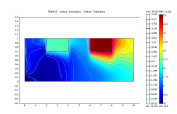
An external magnetic field imposed on a ferrofluid with a temperature gradient, results in a non-uniform magnetic body force, which leads to a form of heat transfer called thermomagnetic convection. A magnet placed near the device will always attract the colder ferrofluid more than ... Read More

Finite Element Method (FEM) simulations are vital in the design of loudspeakers, providing an efficient alternative to traditional trial-and-error methods. This study aims to advance the understanding and optimization of loudspeaker design focusing particularly on the influence of ... Read More
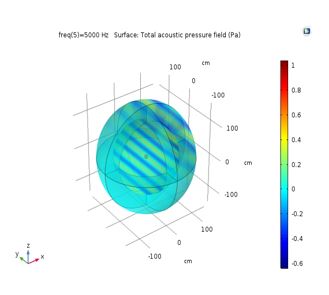
An Acoustic Vector Sensor (AVS) is a compact device used for finding azimuthal as well as elevation angle of an acoustic source using particle velocity and pressure measured at the acoustic center of the device. There are mainly two types of AVS; namely P-P and P-U based AVS. P-P based ... Read More
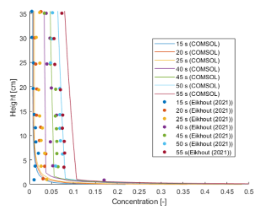
Soil sedimentation and consolidation, whether they are naturally or anthropically driven processes, are closely interconnected. While theoretical models are available to separately describe the behaviour of either ‘fluid’ suspensions or ‘solid’ soil, no well-established unified theory ... Read More

This study investigates the effect of uniform magnetic field on the deformation of a ferrofluid droplet in a two dimensional (2D) simple shear flow by means of numerical simulation. The magnetic field is applied in a perpendicular direction to the flow direction. A numerical scheme ... Read More


