
See How Modeling and Simulation Is Used Across Industries
Multiphysics modeling and simulation drives innovation across industries and academia — as is evidenced by the many uses showcased in the technical papers and posters presented by engineers, researchers, and scientists at the COMSOL Conference each year.
Draw inspiration from the recent proceedings collected below, or, to find a specific presentation or filter by application area or conference year/location, use the Quick Search tool.
View the COMSOL Conference 2025 Collection
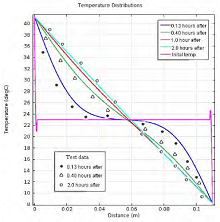
This paper is a part of a study on energy piles for heating and cooling of buildings. Energy piles are used for two reasons: (1) to transfer structural loads to foundation soils, and (2) to transfer heat from foundation soils to the building for space heating in winter time and for ... Read More

The Delmarva Peninsula is located on the East Coast of the United States, between the Chesapeake Bay and Atlantic Ocean. Industrial farming in the Delmarva Peninsula leads to levels of nutrients nitrogen, which grossly exceed natural levels and greatly impair the health of the bay. The ... Read More
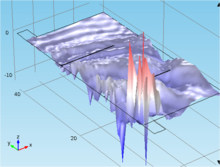
An experimental program has been developed, with the purpose of evaluating the reliability in building diagnosis and characterization of an integrated analysis of several parameters, associated with acoustic waves propagating through the material. The Direct Transmission Technique has ... Read More

Energy piles transfer the mechanical loads from buildings to the ground and serve as heat exchangers. Temperature changes in the ground influence its moisture content. This paper examines the effect of soil moisture content on the shaft resistance of a pile. Tests were carried out in ... Read More

Finite element (FE) modelling of ultrasonic propagation using COMSOL Multiphysics® simulations can be used to create images of waves. Unfortunately, in time-stepping solutions, it is possible for numerical instabilities to grow large and dominate the solution adversely. Any design of ... Read More
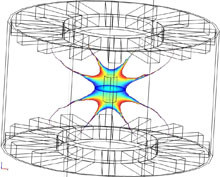
For low-field NMR (Nuclear magnetic resonance), NdFeB permanent magnet arrangements are proposed to provide the static polarizing magnetic field. Especially a parallel and a circular arrangement of the permanent magnets, iron yokes and small shim magnets were tested and improved by ... Read More

Using 2D viscoelastic plane strain models we investigate the dependency of the stress field of slabs on geometry and kinematics of subduction zones (relative velocity of interacting plates and their absolute velocity with respect to the mantle). We conclude that the concentration of Von ... Read More
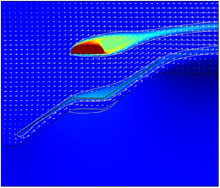
We present COMSOL solutions for a coupled gas flow and heat transfer problem, which occurs particularly when traffic pathways are constructed in high altitude and arctic regions, where the underground is frozen soil. To avoid melting of the frozen ground (which usually leads to ... Read More
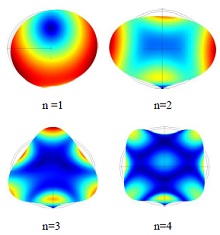
In this paper, a Finite Element (FE) and scaled-up experimental modal analysis are employed to estimate the natural frequencies of individual spherical and ellipsoidal cells. It is apparent that the mechanical properties of the living cells and particularly the natural frequencies might ... Read More

Direct numerical simulation of single- and two-phase flow in real pore systems is addressed in our paper. The X–ray computed micro-tomography technique has been applied first to reconstruct in details a real pore space of a subcentimetric sample. Making use of dedicated software (ScanIP) ... Read More


