
See How Modeling and Simulation Is Used Across Industries
Multiphysics modeling and simulation drives innovation across industries and academia — as is evidenced by the many uses showcased in the technical papers and posters presented by engineers, researchers, and scientists at the COMSOL Conference each year.
Draw inspiration from the recent proceedings collected below, or, to find a specific presentation or filter by application area or conference year/location, use the Quick Search tool.
View the COMSOL Conference 2025 Collection

Turbine blades are coated with thermal barrier coatings (TBCs) to reduce operating temperature. TBCs experience stress from coefficient of thermal expansion mismatch with the bond-coat and substrate. Vertical cracks are thought to offer stress relief, but influence of crack geometry on ... Read More

Matrix Assisted Pulsed Laser Evaporation (MAPLE) technique is used for the deposition of high quality biocompatible polymer thin films. During the deposition process the temperature of the laser target should be kept below 193K to assure the proper quality of both evaporation and ... Read More
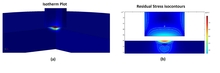
Electrical Discharge Machining (EDM) is a non-conventional process used for machining electrically conducting materials. In die sink-EDM, sparks are generated between tool and workpiece resulting in heating of both electrode surfaces and creating a melt pool of metal which leads to ... Read More

Array-based technologies are important for many applications in drug discovery, microbiology and cell biology. A large-scale array of single cells allows high-throughput monitoring of behaviors of individual cells in parallel, avoiding the lack of cell specificity inherent to bulk ... Read More

Determination of Estrogen Receptor [ER] status is a key in detecting cancer pathogenesis at early stage. In our work we discuss Near Infrared Fluorescence [NIRf] Molecule Optical Imaging Diagnostic modality for early detection of breast cancer. A novel target-specific NIRf dye conjugate ... Read More

Worldwide efforts to promote the use of renewable energies include combustion-based technologies that produce substantial amounts of pollutants. In order to control the environmental impact a proper treatment of exhaust gases is required. This study describes the development of a ... Read More
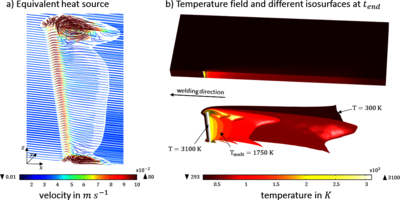
The Finite Element Method (FEM) has become an established numerical tool used for different academic and industrial purposes. It allows the prediction of weld pool geometry, thermal cycle, final distortion and residual stress field during and after fusion welding. The capability of the ... Read More
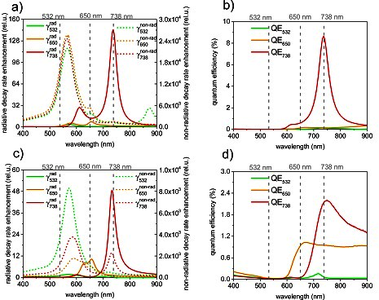
Detecting light emitted by fluorescent molecules with resolution down to single photon is an important problem in various fields of sciences and applications, such as solid-state physics, quantum information processing and medicine. The detection probability can be improved via ... Read More

Introduction: Singlet oxygen (¹O₂) has a critical role in the cell-killing mechanism of photodynamic therapy (PDT). Therefore, in this study, the distance-dependent reacted ¹O₂ is numerically calculated using finite-element method (FEM). Herein, we use a model [Ref. 1] that has been ... Read More
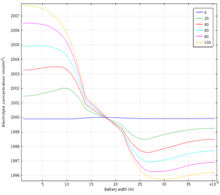
The purpose of this work is to show whether an important difference in Lithium solid concentration and electrolyte concentration can be observed in a Lithium-ion battery model, when considering either the Butler-Volmer kinetics or the Tafel kinetics for describing the electrode kinetics ... Read More


