
See How Modeling and Simulation Is Used Across Industries
Multiphysics modeling and simulation drives innovation across industries and academia — as is evidenced by the many uses showcased in the technical papers and posters presented by engineers, researchers, and scientists at the COMSOL Conference each year.
Draw inspiration from the recent proceedings collected below, or, to find a specific presentation or filter by application area or conference year/location, use the Quick Search tool.
View the COMSOL Conference 2025 Collection

This paper reports the simulation of micro-electro-mechanical system (MEMS) cleanroom for the purpose of determining the effect of particulate contaminants on the static stress response of cantilever type MEMS devices, such as high precision MEMS pressure sensor. The contaminant presence ... Read More
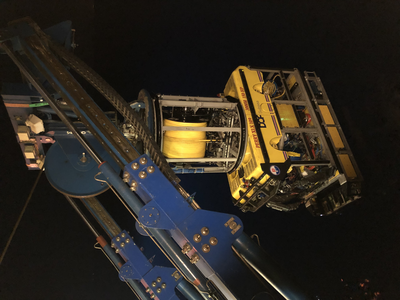
Offshore operations, using Robotically Operated Vehicles (ROVs) in areas with high ambient temperatures require ampacity limitations to be established. Specifically, the risk of overheating ROV umbilicals and tethers when running at high power, due to multiple layers on winch drums is a ... Read More
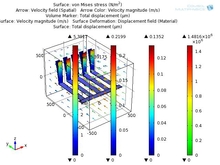
The biological hair-cell is a modular building block of a rich variety of biological sensors. These sensors are responsive to various mechanical properties like vibration, touch, gravitational forces, etc., especially flow. Using micro and nano-fabrication technology, an engineering ... Read More

In this work, we demonstrate the implementation of the micromagnetic equations for the description of ferromagnetic thin films in COMSOL Multiphysics®. We apply our model to magnetoresistive sensors consisting of several soft ferromagnetic layers and their response to magnetic particles. ... Read More
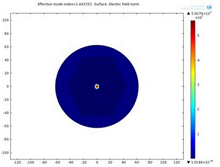
In a solid core PCF, structural parameters and the number of rings in the cladding region decide confinement losses, dispersion coefficients as well as bending losses. This paper evaluates some of commercially available solid core photonic crystal fibers. The dispersion coefficients and ... Read More
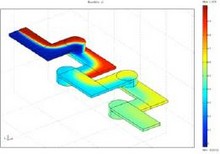
The mixing of liquids was characterized in thirteen different microfluidic devices. The goal was to characterize, in a uniform manner, the flow and mixing that occurred in slow, laminar flow and to present the results that allow quick designs. The mixing of a dilute chemical in another ... Read More
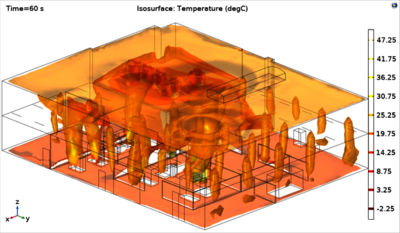
Environmental factors such as temperature and humidity can significantly affect the quality of the metal powder used in power bed fusion additive manufacturing, leading to variations in the integrity of finished components. It is therefore important to monitor and minimize the exposure ... Read More

Mixing is characterized in liquids moving between bubbles when the bubbles are moving down a microfluidic channel. The shape is assumed based on fluid mechanical arguments and experimental observations, and the mixing is characterized for a variety of situations in two and three ... Read More
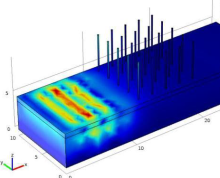
The objective of this paper is to design a 3D Gas Sensor for sensing Hydrogen gas and to increase the conductivity at nano level. In this novel design, nanorods act as the sensing layer. The sensitivity towards gas adsorption is found to be increased due to its high surface to volume ... Read More
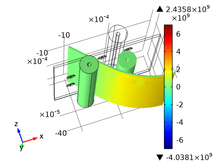
Ultra-thin chips of less than 20µm become flexible, allowing integration of silicon IC technology with highly flexible electronics. This combination allows for highly intelligent products of unprecedented thinness, flexibility and cost. Examples include sensor systems integrated into ... Read More


