
See How Modeling and Simulation Is Used Across Industries
Multiphysics modeling and simulation drives innovation across industries and academia — as is evidenced by the many uses showcased in the technical papers and posters presented by engineers, researchers, and scientists at the COMSOL Conference each year.
Draw inspiration from the recent proceedings collected below, or, to find a specific presentation or filter by application area or conference year/location, use the Quick Search tool.
View the COMSOL Conference 2025 Collection
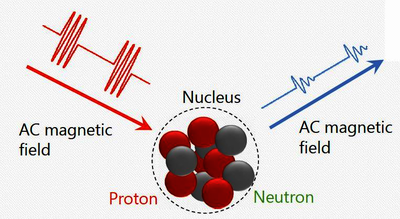
In the humanitarian demining setting, it is crucial to detect landmines with reliable sensing performance. As Nuclear Quadrupole Resonance (NQR) is an effective method for detecting explosive materials, our group is currently developing the world’s first low-cost system for anti-vehicle ... Read More

Photoacoustic spectroscopy (PAS) enables highly sensitive gas detection without optical detectors by directly measuring the sound generated from light absorption. However, the performance of PAS systems strongly depends on the photoacoustic cell’s acoustic design. In this work, we ... Read More
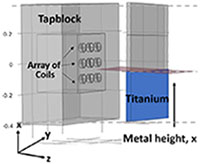
Pyrometallurgical furnaces are used to produce metals such as copper, nickel and platinum by the smelting process. During smelting, the undesired material components are separated from the desired metal resulting in the formation of a slag and matte/metal phase. The slag phase ... Read More

Crack detection is and has been an active field of exploration, both theoretical and applied for a number of years. It is the belief of this author that the concepts presented herein explore a new methodology for the modeling and the detection of cracks and families of cracks in ... Read More

A new filter-less method of detecting the spectrum based on wavelength absorption in silicon is proposed. Wavelength dependent absorption coefficient produces a unique excess carrier distribution. Thus the wavelength spectral information can be obtained by measuring the photon generated ... Read More

Increased traffic and load on railway infrastructure require regular inspection of track components. Railway track elements such as fasteners, insulation joints, and weld joints are subjected to extreme loading conditions, making their regular inspection essential for ensuring the safety ... Read More
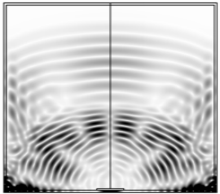
Introduction In order to understand the detection mechanism of the PZT based nondestructive testing (NDT) technology for interface debonding of CFSTs, numerical simulation on a multi-physical model composed of surface-mounted PZT patches and CFST structural member is established in ... Read More

High temperature superconductors (HTS) such as YBCO coated conductors show great promise for future applications where high magnetic fields are needed. The superconducting state only exists under a critical surface defined in the (J,T,B) space. Quench is the process by which a current ... Read More
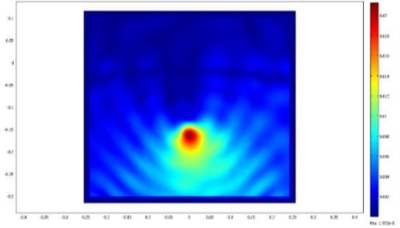
The detection, characterization, and classification of underground environmental hazardous objects [mines, IEDs, and other unexploded military hardware] is a worldwide problem that needs urgent attention and solution. While electromagnetic sensor technologies have been applied to ... Read More

This paper presents the design and simulation of a thermal sensor using COMSOL Multiphysics® software for the detection of low body temperature syndrome which can allow the early detection of cancer. This sensor is made of an alloy consisting of two materials with different coefficients ... Read More


