
See How Modeling and Simulation Is Used Across Industries
Multiphysics modeling and simulation drives innovation across industries and academia — as is evidenced by the many uses showcased in the technical papers and posters presented by engineers, researchers, and scientists at the COMSOL Conference each year.
Draw inspiration from the recent proceedings collected below, or, to find a specific presentation or filter by application area or conference year/location, use the Quick Search tool.
View the COMSOL Conference 2025 Collection
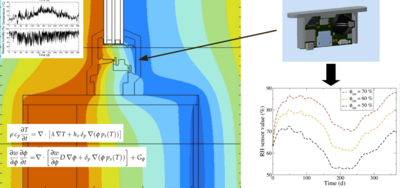
The material wood is frequently used in construction industry for several elements such as window frames. However, as a hygrothermal material, wood is sensitive to moisture induced damage. In this context, the moisture uptake of wood based windows logged with an integrated relative ... Read More
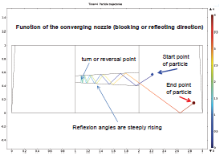
During examination of molecular gas flow in freeze dryers in near-vacuum properties, an idea came up to model a molecular fish trap nozzle. An appropriate shape of this fish trap nozzle allows to separate free flowing molecules into 2 chambers, and obtain a pressure gain in a isothermal ... Read More

The high power of X-ray beam delivered by synchrotrons and free electron lasers, up to 240 W/mm2, requires heat load management solutions to obtain the best performance from the optical elements which will shape the beam for its use in the experimental stations [1]. One solution is the ... Read More
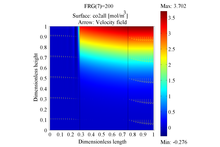
A comprehensive mathematical model that includes mass and heat transfer was developed for the transport of gas mixture of carbon dioxide and methane through hollow fiber membrane (HFM) contactor. COMSOL Multiphysics® was used in solving the set of partial, ordinary and algebraic ... Read More
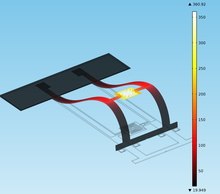
In semiconductor gas sensors, the base of the gas detection is the interaction of the gaseous species at the surface of the semiconducting sensitive material. Since the chemical reactions at the surface of the sensor material are functions of temperature. We simulate our µHeater design ... Read More
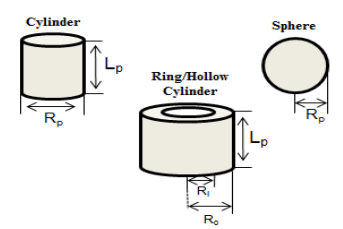
In the early 1920’s, Gas-To-Liquids (GTL) and Coal-To-Liquids (CTL) technologies were developed to account for the depleting crude oil resources [1]. During this period, Franz Fischer and Hans Tropsch developed a process to convert synthesis gas (syn gas), derived from coal ... Read More
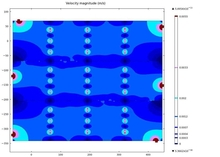
The Gas Electron Multiplier (GEM) technology has been proven to tolerate rate larger than 50 MHz/cm2 without noticeable aging and to provide the sub millimeter resolution on working chambers up to 45x45 cm2. A new GEM based tracker is under development for the Hall A upgrade at ... Read More
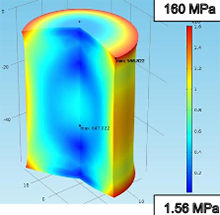
Our safety analysis group in the Research Reactors Division of Oak Ridge National Laboratory supports a project to investigate the production of Pu-238 isotope for missions of deep space travel in the High Flux Research Reactor. COMSOL Multiphysics® has been used to support this activity ... Read More
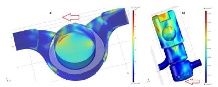
Industrial applications of fluid mechanics can require to satisfy necessities as diverse as legal norms, optimization requirements and manufacturing constraints. Therefore a Computational Fluid Mechanics software often becomes a must in the development of new devices or the improvement ... Read More
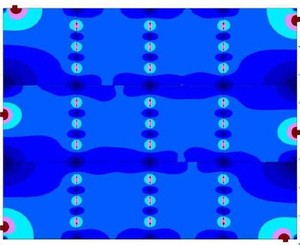
A Computational Fluid Dynamics study has been performed for a Gas Electron Multiplier (GEM) detector of high energy charged particles, currently under development as part of a new tracker of the high luminosity spectrometers in Hall A at Jefferson Lab. By gradual modifications of the ... Read More


