
Explore the innovative ways multiphysics simulation is being used worldwide to advance research
Multiphysics modeling and simulation drives innovation across industries and academia — as is evidenced by the many uses showcased in the technical papers and posters presented by engineers, researchers, and scientists at the COMSOL Conference each year.
Draw inspiration from the recent proceedings collected below, or, to find a specific presentation or filter by application area or conference year/location, use the Quick Search tool.
View the COMSOL Conference 2025 Collection

Flash lamp annealing (FLA) is a modern annealing technique in the range of milliseconds, which is predestinated for roll-to-roll fabrication of battery electrodes. All-solid-state batteries are the next generation battery concepts that are currently being envisaged among both the ... Read More

Of utmost importance in appliance design and manufacture are the features for protection from fire and for personal safety. Appliance engineers are continually in pursuit of better,longer-life appliances that will provide both lower cost to the consumer and lower energy consumption. ... Read More

Electric vehicles (EVs) powered by rechargeable lithium-ion batteries (LIBs) have been developed as a replacement for the conventional internal-combustion-engine automobiles. Research has been yielding a stream of improvements to the traditional LIB technology, focusing on energy and ... Read More

In this study, a three-dimensional (3-D) phase field model was developed to better understand the parameters impacting the LiFePO4 cathode material in lithium ion batteries. LiFePO4 has a strong tendency to separate into stable high Li+ concentration and low Li+ concentration phases, ... Read More

This research proposed a novel battery thermal management system that utilized the heat pipe coupling composite fin (HPCF) which consisted of aluminum fin, phase change material and liquid cooling tube. By using battery module, heat transfer module and CFD module of COMSOL, the ... Read More

Lithium ion battery safety problem has attracted the whole world’s attention essentially after the explosion of Samsung Note 7. This work mainly deals with the study of the generation, characteristics and prevention measures of the battery fire. Firstly, the heat generation rate of ... Read More

The most common cause of lithium ion battery failure is high temperature. Improper thermal management strategies can contribute to the temperature related premature battery failure. Excessive heat significantly impacts the performance, safety and cycle lifetime of the lithium ion ... Read More
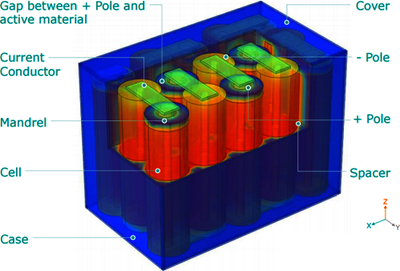
Vehicles with battery as energy storage fascinate more and more people. Meanwhile, more questions are surfaced – How to ensure a safe operation of the battery package? How long could the cycle life of a battery package reach? Can a battery package be operated in any environmental ... Read More

Li-ion battery is being used as power source for various applications. Smart battery diagnostics is essential for creating a better control over the energy storage system and cycle life of a Li-ion battery. It is especially required for real time applications, where more power and energy ... Read More

The discharge of an alkaline Zn anode involves the conversion of Zn metal to solid ZnO through the zincate ion. With the heterogeneous dissolution of Zn and mobility of zincate in the electrolyte, complex radial distributions of Zn and ZnO have been observed to occur in the anodes of ... Read More


