
See How Modeling and Simulation Is Used Across Industries
Multiphysics modeling and simulation drives innovation across industries and academia — as is evidenced by the many uses showcased in the technical papers and posters presented by engineers, researchers, and scientists at the COMSOL Conference each year.
Draw inspiration from the recent proceedings collected below, or, to find a specific presentation or filter by application area or conference year/location, use the Quick Search tool.
View the COMSOL Conference 2025 Collection

Accurate magnetic field simulations are crucial in the design and optimization of advanced electromagnetic systems of the multi-beam mask writers (MBMWs). In MBMW systems, thousands of electron beams are focused with nanoscale precision within a small region close to the axis [μm], while ... Read More

This study presents a numerical investigation of optical butt-coupling between Vertical-Cavity Surface-Emitting Lasers (VCSELs) operating at 850 nm and Standard Single-Mode Fiber (SSMF), a widely adopted configuration in cost-effective, high-speed optical interconnects, especially in ... Read More

Our customer LeydenJar Technologies creates the world’s most energy dense battery anodes, enabling Li-ion batteries that are powerful, small and fast charging. Prime examples of applications include electronic devices and e-mobility. The anodes are made of silicon, and are produced with ... Read More

Binary meta-optical structures offer many new possibilities in the efficient manufacturing of products like diffractive beam splitters, phase correction elements, gratings and many more. At JENOPTIK we manufacture a variety of optical elements, based on electron beam lithography (EBL) ... Read More
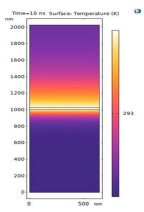
Laser-induced photovoltage in ferromagnetic thin films is often explained by magneto-thermoelectric effects such as the anomalous Nernst effect (ANE). ANE appears when thermal gradients interact with magnetization. While power loss in flat films can be estimated analytically, numerical ... Read More

Balises are an essential part of pointwise train control systems ensuring the operational safety. Combined with a corresponding onboard unit, it represents an inductive transponder system (Fig. 1). During a crossing, the balise is activated by the 27 MHz magnetic field of the vehicle ... Read More
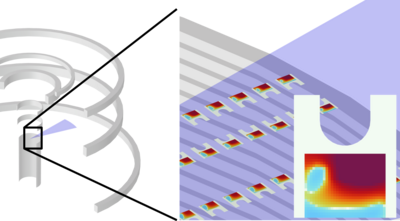
The AC losses that superconducting magnet systems experience during transient events are an important design consideration in fusion reactors. We present results on the approach for calculating AC losses in the high temperature superconducting (HTS) toroidal field (TF) magnets of the ... Read More

This case study explains the work we undertook where we modelled an Induction heating system in COMSOL Multiphysics simulation software to correlate the simulation results with actual measurements. The simulated results were cross checked with several different measurement scenarios, ... Read More

Background: Magnetic Induction Tomography (MIT) is an electromagnetic imaging technique that maps a material's electrical conductivity by inducing eddy currents via a primary oscillating magnetic field. The resulting secondary magnetic fields from the eddy currents are measured for image ... Read More

As semiconductor devices continue to shrink and incorporate complex 3D architectures, conventional optical metrology faces limitations in resolving features smaller than the optical wavelength or those hidden beneath opaque layers. Ultrafast photoacoustic spectroscopy provides a ... Read More


