
Explore the innovative ways multiphysics simulation is being used worldwide to advance research
Multiphysics modeling and simulation drives innovation across industries and academia — as is evidenced by the many uses showcased in the technical papers and posters presented by engineers, researchers, and scientists at the COMSOL Conference each year.
Draw inspiration from the recent proceedings collected below, or, to find a specific presentation or filter by application area or conference year/location, use the Quick Search tool.
View the COMSOL Conference 2025 Collection

Understanding the air flow patterns and aerosol trajectories in ventilated rooms can provide key information for determining where to place early warning and monitoring instruments, and how to minimize hazardous materials in the worker’s breathing zone. The dispersion within rooms can be ... Read More

Descemet membrane detachment (DMD) happen when the aqueous humour (AH) in the aqueous chamber flow into the descrement membrance (DM) space through a break and separate the membrane from the stroma. This often happen after the cataract surgery. The fluid is driven by the buoyancy force ... Read More

Different facilities for hadrontherapy have been built in the recent past. AISHa ion source has been designed by keeping in mind the typical requirements of hospital-based facilities, where the minimization of the mean time between failures (MTBF) is a key point together with the ... Read More

This document has been produced by Washington River Protection Solutions, LLC on behalf of the Department of Energy (DOE) for the use of COMSOL when simulating applications related to DOE's waste management. COMSOL has been classified as a grade D acquired software program and this ... Read More

The radio-frequency(RF) plasma sources have shown great potential in various industrial applications such as thin coatings deposition and polymers modification[1,2]. Physics of low pressure RF plasmas has been investigated significantly[3]; however, this kind of plasma source is rarely ... Read More
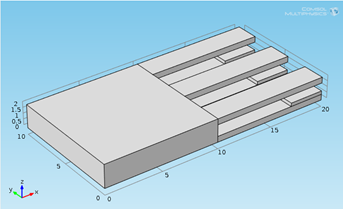
This article describes the design of MEMS based cantilever structure intended for determination of blood group and it is compared with manual method. Cantilever structure design has a sensing layer and when a blood sample comes in contact with this, results in coagulation. The surface ... Read More

A dual axis MEMS seismometer targeted for building monitoring system has been simulated for a full scale of ±5g acceleration. The design uses the capacitive effect for vibration sensing. This comb drive capacitive MEMS seismometer consists of 8 springs with two proof masses. The device ... Read More

Magnetorheological Finishing (MRF) is one of the precision finishing processes in which magnetic field is used to drive abrading forces for Finishing 2D and complex 3D surfaces. In this paper, Ball End Magnetorheological Finishing (BEMRF) has been analyzed for fluid behaviors under the ... Read More

Performance of tactile sensation is affected by fingertip deformation characteristics produced when touching objects. Tactile performance of human fingertips is strictly associated with activity of the nerve endings and sensitivity of the soft tissue within the fingertip to the static ... Read More
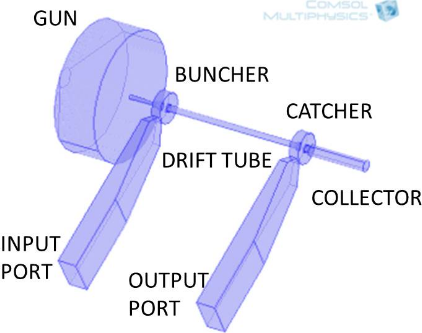
The multiphysics analysis of a 130 GHz klystron is described in this paper. Critical quantities are exposed to multiple physics effects acting on narrow dimensions modified by power dissipations. The proposed device uses an integrated injection/bunching section described in last COMSOL ... Read More


