
Explore the innovative ways multiphysics simulation is being used worldwide to advance research
Multiphysics modeling and simulation drives innovation across industries and academia — as is evidenced by the many uses showcased in the technical papers and posters presented by engineers, researchers, and scientists at the COMSOL Conference each year.
Draw inspiration from the recent proceedings collected below, or, to find a specific presentation or filter by application area or conference year/location, use the Quick Search tool.
View the COMSOL Conference 2025 Collection
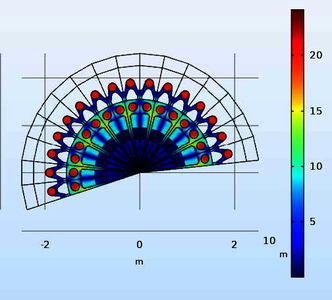
高温气冷堆中使用了大量的碳素材料,作为多孔材料,碳素材料含有一定水分等杂质。为了减小反应堆高温运行条件下的堆内材料腐蚀,高温堆在初装堆和事故后需要对一回路进行严格的加热除湿操作。目前一回路加热除湿主要是依靠主氦风机旋转,将动能转换为热能来提升温度。本文将采取另外一种方案,在蒸汽发生器处增加外加热源来加热一回路工质。基于大型商用软件COMSOL Multiphysics建立高温堆内一回路加热的流动传热模型,对两种加热方案的一回路升温过程作数值分析,为高温堆加热除湿方案的选择提供有益的指导。本文中使用的物理场为传热——共轭传热——湍流,多物理场耦合为非等温流动。 Read More

A resonant MEMS sensor for viscosity and mass density measurements of liquids was modeled. The device is based on Lorentz-force excitation and features an integrated piezoresistive readout. The core sensing element is a rectangular vibrating plate suspended by four beam springs. The ... Read More
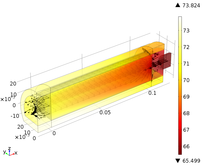
Heat sinks for cryogenic applications using helium gas as the coolant are not readily available. They require to be designed specifically for the intended application. A finite element model was developed to study the feasibility and optimize the design. The FEM computing package COMSOL ... Read More

Dielectrophoresis (DEP) is a method for cell manipulation without physical contact in lab-on-chip devices, since it exploits the dielectric properties of cells suspended in a microfluidic sample, under the action of locally generated high-gradient electric fields. The DEP platform that ... Read More

In this paper we present a novel approach for modeling spatial distributed bio- chemical and environmental processes like the growth of plants and the related biochemical reactions. The physical phenomena like flow and mass transport can be described by fluid dynamics equations, but for ... Read More

Crust which develops at the surface of meat leads to reactions which affect food color, flavor and safety. Whole pieces of meat are only contaminated by microorganisms at their surface. Thus intense thermal treatment can inactivate pathogenic bacteria; however the associated high ... Read More

An attempt has been made to sustain the efficiency of an air pre-heater(APH) in the long run. The APH is modeled using COMSOL Multiphysics in 3D and fed with real life conditions. Upon Heat transfer analysis, the temperature profile was found out and from that, the regions undergoing ... Read More

The quality of coatings obtained by means of thermal spraying depends strongly on the mechanism of the interaction between the molten droplets and the surface to be covered. The aim of the present study is to simulate the impact of a droplet onto a substrate, in order to have a good ... Read More
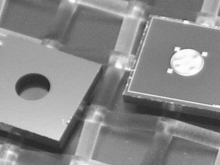
The MEMS microphone is also called microphone chip or silicon microphone. The pressure sensitive diaphragm is etched directly into a silicon chip by MEMS techniques and is usually accompanied with integrated preamplifier. Most MEMS microphones are variants of the condenser microphone ... Read More

The use of ventilated facades may reduce the cooling and heating energy demands of the building. Double-skin facades (DSFs) belong to the wider group of ventilated facades and currently represent one of the most interesting and studied facade systems. The purpose of this study is to ... Read More


