
See How Modeling and Simulation Is Used Across Industries
Multiphysics modeling and simulation drives innovation across industries and academia — as is evidenced by the many uses showcased in the technical papers and posters presented by engineers, researchers, and scientists at the COMSOL Conference each year.
Draw inspiration from the recent proceedings collected below, or, to find a specific presentation or filter by application area or conference year/location, use the Quick Search tool.
View the COMSOL Conference 2025 Collection

When studying the behavior of a MEMS or electret microphone it is important to consider the design of the inlet or sound channel (tube) that defines how the acoustic signal gets into the microphone, as well as the design of other internal acoustic components such as acoustic chambers and ... Read More

Finite Element Method (FEM) simulations are vital in the design of loudspeakers, providing an efficient alternative to traditional trial-and-error methods. This study aims to advance the understanding and optimization of loudspeaker design focusing particularly on the influence of ... Read More

This work reports the application of topology optimization for the design of two types of metallic antennas that are very different from each other: a leaky-wave antenna (LWA) radiating at broadside, and an epidermal patch antenna, optimized to favor radiation coupling into the human ... Read More

As part of its research, the Group of Electrical Engineering-Paris (GeePs) uses COMSOL Multiphysics software for applications such as material modelling in Electrical Engineering, electromagnetic compatibility and Eddy current non-destructive testing (EC-NDT). EC-NDT is an easy-to-use ... Read More
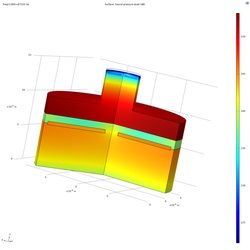
Condenser microphones will have an electrical output for any displacement of the membrane relative to the back plate, which is usually bound to the microphone housing. For the typical use case, a pressure input will create a pressure difference across the membrane, which causes a ... Read More

In the context of climate change mitigation, hydrogen represents a promising and versatile energy vector. Water electrolysis powered by renewable energy offers a sustainable method for hydrogen production, with efficiency gains achievable at the higher operating temperatures of Solid ... Read More

The protection of metal surfaces against corrosion is commonly achieved by the application of organic coatings. A dedicated evaluation of those coating systems is strictly necessary before putting them into service. While outdoor test programs are time intensive and accelerated corrosion ... Read More

Polydimethylsiloxane (PDMS) is a biocompatible material widely used in biomedical applications such as implantable sensors. A realistic modeling of PDMS in acoustic-mechanic simulation is useful especially for medical applications which use ultrasonic waves as interrogation source. ... Read More

Foundation scour is a major cause of bridge collapse worldwide (e.g., Kirby et al., 2015). Indeed, several studies have demonstrated its detrimental effects on the soil-structure system, both in terms of the foundation capacity and stiffness (e.g., Foti et al., 2023). Furthermore, the ... Read More
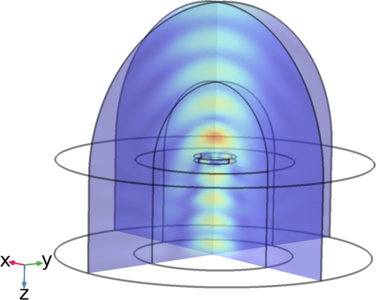
Multilayer transition metal dichalcogenides (TMDCs) are an emerging class of dielectric materials with promising applications in modern nanophotonics. They exhibit a much higher refractive index (~ 4 - 4.5) than traditional semiconducting materials like Silicon (~ 3.5) in the near ... Read More


